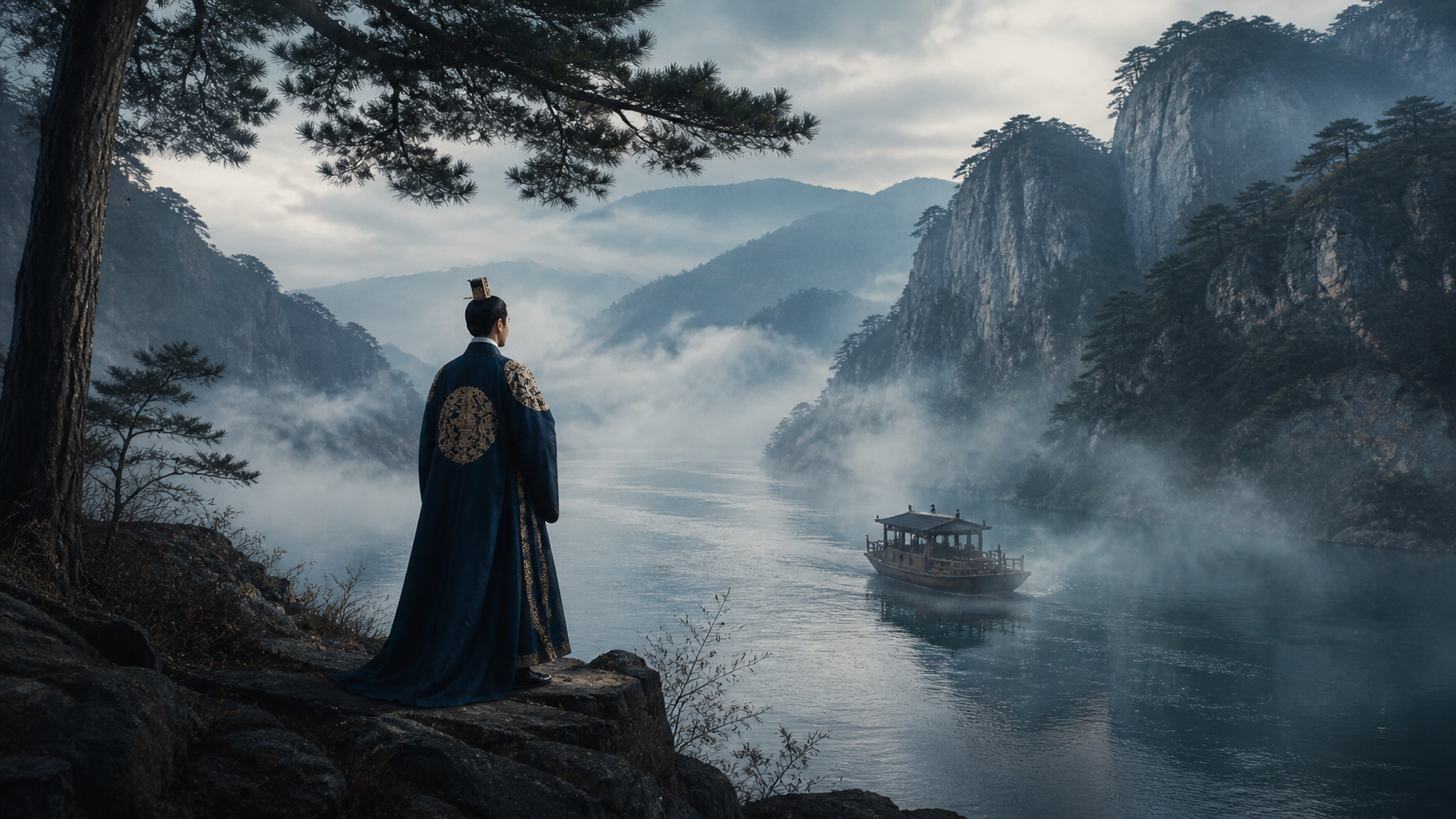
The True Story of Joseon’s Exiled King (What the Film Did Not Tell You)
※ This article was first published on May 05, 2026, and last updated on May 05, 2026.
This travel information is for general reference only and does not guarantee safety, accessibility, or current availability of destinations, services, or events. Travel conditions, entry requirements, and safety situations can change rapidly. Always check official sources and prioritize personal safety when traveling.
Cover image credit: Image generated by AI (ChatGPT, 2026). AI-generated images are strictly for editorial purposes only, comply with free commercial-use licenses (Unsplash, Pixabay, Pexels), and are not permitted for resale or standalone commercial use. Images do not depict actual people, places, or events.
Editorial & AI Assistance Notice: This article was prepared by HACKsKorea editors with AI assistance (Claude). All facts were verified against official government and institutional sources. This is general information only, not legal advice. Users must confirm the latest details through official government websites or authorized agencies. For official inquiries, please contact the Korea Immigration Service through HiKorea (Call Center 1345, multilingual support available).
This travel information is for general reference only and does not guarantee safety, accessibility, or current availability of destinations, services, or events. Travel conditions, entry requirements, and safety situations can change rapidly. Always check official sources and prioritize personal safety when traveling.
Summary at a Glance
When the credits rolled on The King’s Warden, millions of Korean viewers found themselves reaching for their phones to search one question: how much of this actually happened? The film centers on the final months of King Danjong (단종), the sixth ruler of the Joseon Dynasty, a teenage king whose short life became one of Korea’s most enduring historical tragedies. The answer to that question is both simple and devastating: almost all of it.
King Danjong was born on December 9, 1441, the son of Crown Prince Munjong and Queen Hyeondeok (현덕왕후). His mother died within days of giving birth, and his father — later King Munjong — would follow her just two years into his own reign. Orphaned before adolescence and thrust onto the throne at approximately twelve years old, Danjong was never truly given a chance to rule.
What followed was a calculated dismantling of everything that stood between his uncle, Suyang Daegun (수양대군), and absolute power. The political coup of 1453 — known as the Gyeyujeongnan (계유정난) — eliminated the most capable ministers who could have protected the young king. By 1455, with no allies left and facing a threat he could not name openly, Danjong abdicated the throne to his uncle, who became King Sejo (세조).
Even that surrender did not satisfy Sejo’s need for security. After a failed attempt by a group of loyal scholars to restore Danjong to the throne in 1456, Danjong was demoted from retired king to a common nobleman’s title — Nosangun (노산군) — and sent into exile at Cheongnyeongpo (청령포), a remote peninsula in Yeongwol (영월), Gangwon Province. He was seventeen years old. He never returned.
This article traces the full arc of Danjong’s life, the political machinery that destroyed him, and the remarkable legacy that outlasted his killers by centuries. Whether you have just watched The King’s Warden or are arriving at this story for the first time, what you are about to read is the history that the film was built on — and in many ways, the history that Korea has never stopped mourning.
Key Facts at a Glance: • Born: December 9, 1441 | Died: October 1457 (age 17) • Reigned as king: 1452–1455 (approximately three years) • Forced to abdicate in favor of his uncle, King Sejo (세조) • Exiled to Cheongnyeongpo (청령포), Yeongwol, Gangwon Province • Posthumously restored to full royal status in 1698 by King Sukjong (숙종) • His tomb, Jangneung (장릉), is a UNESCO World Heritage Site in Yeongwol
Historical Context: Understanding the Joseon Dynasty and Danjong’s World
To understand the tragedy of King Danjong, it is necessary to understand the Joseon Dynasty (조선왕조) at the precise moment of his birth. Founded in 1392 by General Yi Seonggye (이성계), who became King Taejo (태조), Joseon was a Confucian bureaucratic state built on the principle that governance should be shared between the king and his scholar-officials. This system produced brilliant administrators, rigorous recordkeeping, and one of the most extensively documented dynasties in East Asian history — and it also created the conditions for vicious power struggles when a weak king sat on the throne.
Danjong’s grandfather, King Sejong the Great (세종대왕), was arguably the most capable ruler Joseon ever produced. He oversaw the creation of the Korean alphabet (한글), advances in science and agriculture, and a period of cultural brilliance that defined the dynasty’s highest aspirations. His son, King Munjong (문종), inherited the throne in 1450 with every expectation of continuing that tradition. Munjong was scholarly, thoughtful, and deeply attached to his only son. He also suffered from chronic illness throughout his reign, and in 1452, after just two years on the throne, he died.
His final act was to entrust his son to the care of the state’s most senior ministers, foremost among them Kim Jong-seo (김종서), the great general and statesman who had defended Korea’s northern borders against Jurchen incursion. Munjong believed that Kim Jong-seo and the Council of State (의정부) would serve as guardians for a king too young to protect himself. It was a reasonable hope. It was also one that did not survive the year.
Danjong was officially crowned the sixth king of Joseon in June 1452. He was, by various accounts, between ten and twelve years old. Court protocol required him to conduct rituals, receive ministers, and perform the ceremonial functions of kingship. But the real decisions were made by the men around him — and the most dangerous of those men was his father’s younger brother, Prince Suyang (수양대군).
Suyang was everything Munjong was not: physically imposing, politically ruthless, and impatient. He had watched his older brother rule with scholarly restraint while men like Kim Jong-seo held genuine influence. He saw in his nephew’s youth an opportunity that might not come again. Suyang’s closest advisor was Han Myung-hoe (한명회), a man of low official rank but extraordinary strategic intelligence, who would prove to be the true architect of what came next. Together, they began the quiet, deliberate construction of a network that would eventually dismantle a dynasty’s constitutional protections in a single night.
The political world Danjong entered as king was one in which loyalty was professed constantly and practiced selectively, in which the Confucian rhetoric of service to the rightful ruler coexisted with the practical reality that power flowed toward those willing to use force. Danjong, educated for kingship but denied the years needed to develop the political instincts that might have protected him, was entering that world at the worst possible moment with the most inadequate possible protection.
The Rise and Fall: King Danjong’s Chronological Timeline
Step 1: Ascending the Throne (1452) — The Accession of a Child King (어린 왕의 즉위)
- Timeframe: May–June 1452
- Key figures: King Munjong (deathbed), Kim Jong-seo, Grand Queen Dowager
- Significance: The beginning of a reign that was never truly his own
The King’s Warden opens in the shadow of this moment — a boy already stripped of every protector his father tried to provide. To understand why the film’s warden finds himself guarding a king with no power, the story begins here.
When King Munjong lay dying in the summer of 1452, the court faced a succession that offered no good options. His heir was a child. No formal regency council had been established. And among the royal family, Munjong’s younger brothers — particularly Suyang — were already positioning themselves.
Danjong’s coronation took place on June 1, 1452. Dressed in ceremonial robes far too large for his small frame, he received the bows of ministers who were already calculating how long his reign would last. Kim Jong-seo emerged as the de facto power behind the throne, and his authority, combined with that of the chief state councilors, formed the protective barrier Munjong had hoped for.
For roughly a year, that barrier held. The court functioned. Ministers debated policy. Danjong performed his ceremonial duties. But under the surface, Suyang was quietly cultivating allies, building a private network of soldiers and sympathizers, and waiting for the right moment. The young king’s survival depended entirely on the continued ability and willingness of men like Kim Jong-seo to protect him from an uncle who had already decided that the throne belonged by right to someone more capable of using it.
💡 Pro Tip: The records of Danjong’s reign are preserved in the Joseon Wangjo Sillok (조선왕조실록), the official annals of the Joseon Dynasty, which are now fully digitized and searchable through the National Institute of Korean History (국사편찬위원회) at sillok.history.go.kr.
⚠️ Note: Many popular accounts conflate the coup of 1453 with Danjong’s abdication in 1455. These were two separate events, two years apart, in a carefully staged process of political consolidation that moved from military control to formal throne transfer.
Step 2: The Coup (October 1453) — Gyeyujeongnan (계유정난)
- Timeframe: October 10, 1453
- Key figures: Suyang Daegun, Han Myung-hoe, Kim Jong-seo (killed), Hwang Bo-in (killed)
- Significance: The violent seizure of political control that made everything else possible
The King’s Warden never depicts this night directly — but every scene of confinement and powerlessness in the film flows from what happened here. This is the event that created the king the warden is tasked with guarding.
The night of October 10, 1453, is one of the most precisely documented acts of political violence in Korean history. Suyang Daegun arrived at Kim Jong-seo’s residence under the pretext of a private visit. With his soldiers waiting outside, he confronted the elderly statesman directly and personally participated in his killing. Within hours, several other ministers who might have resisted were also dead or arrested. The coup is named Gyeyujeongnan (계유정난) — the Disturbance of the Gyeyu Year, referring to the year in the sexagenary calendar cycle.
The action was swift, targeted, and completely successful. By morning, Suyang had control of the military apparatus and had installed his allies in every position of importance. Crucially, Danjong himself was not removed at this point. Suyang did not want to appear as a usurper. Instead, he positioned himself as the king’s protector, a strong uncle who had saved the dynasty from corrupt ministers. He became Supreme Royal Councilor (영의정), effectively the prime minister, with unchecked authority over state affairs.
Danjong was now a king in name only. He was twelve or thirteen years old, his protectors were dead or imprisoned, and the man who had killed them now controlled access to the throne. Contemporary accounts suggest that Danjong understood his situation clearly. He was described by officials who saw him during this period as “pale and silent” — a description that carries more weight than any formal record.
💡 Pro Tip: The coup also eliminated Hwang Bo-in (황보인), another powerful minister and key supporter of Danjong. The removal of both Kim Jong-seo and Hwang Bo-in in a single night left the young king completely without effective protection within the existing governmental structure.
⚠️ Note: Suyang’s use of the term “loyal service” to describe the killings reflects Joseon’s Confucian political vocabulary. In official records compiled under his later rule, the coup was framed as a necessary act of loyalty to the dynasty rather than as the political murder it actually was.
Step 3: The Forced Abdication (1455) — Throne Surrendered Under Duress (강제 양위)
- Timeframe: June 1455
- Key figures: Suyang (becoming King Sejo), Danjong (becoming Sangwang), Queen Jeongsun
- Significance: The formal end of Danjong’s reign and the beginning of his political erasure
The separation of Danjong and Queen Jeongsun that The King’s Warden treats as one of its most emotionally devastating facts begins here — not at the moment of exile, but two years earlier, when the world they shared as king and queen was officially dismantled.
For two years after the coup, Suyang consolidated power while maintaining the fiction of serving under his nephew. Then in June 1455, the fiction was dropped. Under circumstances that official records describe with careful vagueness — but which historians have long interpreted as coercion — Danjong abdicated the throne.
The formal document of abdication had Danjong expressing that he was “unworthy” and “unable to bear the weight of the dynasty.” He was thirteen or fourteen years old. He was surrendering the throne to the man who had murdered his protectors and dismantled every source of support available to him. Suyang accepted the abdication and became King Sejo. Danjong received the title Sangwang (상왕), meaning “the king above,” a traditional honorific for a retired king, and was housed in Changgyeonggung Palace (창경궁) with a small staff.
Queen Jeongsun (정순왕후 송씨), Danjong’s young queen, remained at his side. She was approximately the same age as her husband, a match arranged during the brief period of relative stability following his coronation. Her loyalty to him through everything that followed became one of the most extraordinary stories of fidelity in Korean history — a story that would outlast nearly everyone else connected to these events.
💡 Pro Tip: Sejo’s reign (1455–1468) was paradoxically one of the more capable administrations in Joseon history. He codified laws, strengthened central authority, and was an effective ruler. This complexity — a capable king who rose through murder — is central to how Korean historical culture has wrestled with his legacy across five centuries.
⚠️ Note: The title Sangwang carried no political authority whatsoever. It was entirely symbolic, a face-saving gesture that provided Danjong no actual protection from the further steps that Sejo would take to secure his position.
Step 4: The Failed Restoration (1456) — The Six Martyred Ministers (사육신의 거사)
- Timeframe: June 1456
- Key figures: Seong Sam-mun, Park Paeng-nyeon, Ha Wi-ji, Yi Gae, Yu Seong-won, Kim Mun-gi
- Significance: The last attempt to save Danjong, and the act that sealed his fate
This is the event that made the exile of The King’s Warden inevitable. Before this conspiracy failed, Danjong was a retired king under house supervision. After it, he became a political liability whose continued existence Sejo could no longer tolerate.
Among the scholars and officials who had served under Danjong, a small group refused to accept the legitimacy of Sejo’s rule. They were men trained in Confucian ethics, for whom loyalty to the rightful king was not merely a political position but a moral absolute. The leader of this group was Seong Sam-mun (성삼문), a brilliant scholar who had worked closely with King Sejong on the creation of the Korean alphabet and was regarded as one of the finest minds of his generation.
In June 1456, they planned an assassination. The occasion was a state banquet at which they intended to kill Sejo and restore Danjong to the throne. The plan was betrayed — accounts differ on who informed Sejo, but the result was immediate and brutal. The conspirators were arrested, tortured, and executed. Their families were enslaved or killed. The degree of punishment was extreme even by the standards of the time, reflecting the depth of Sejo’s fear and fury at the challenge to his legitimacy.
The six men executed for this conspiracy became known as the Sayuksin (사육신), the Six Martyred Ministers. They have been venerated in Korean history as exemplars of loyalty and moral courage — men who chose death over complicity with an illegitimate ruler. For Danjong, however, the failed restoration was catastrophic. Sejo could no longer afford to maintain even the symbolic pretense of the retired king’s dignity. Within weeks, Danjong was stripped of his royal title and demoted to Nosangun (노산군), a status equivalent to a deposed nobleman. He was no longer a king of any kind. He was a politically dangerous man with royal blood.
💡 Pro Tip: Sayuksin Historical Park (사육신역사공원) in Dongjak-gu, Seoul, marks the burial site of the Six Martyred Ministers. Their graves were unmarked for generations after their execution, maintained in secret by local residents. The park is now a formal commemorative site that receives visitors throughout the year.
⚠️ Note: Seong Sam-mun’s torture and execution were reportedly witnessed by Sejo himself. Historical records describe the confrontation between them, in which Seong Sam-mun reportedly refused to acknowledge Sejo as his king even under torture — using the honorific appropriate for a prince rather than a ruler.
Step 5: Exile and Death (1457) — Cheongnyeongpo and the Final Chapter (청령포와 최후)
- Timeframe: January–October 1457
- Key figures: Danjong, the wardens of Yeongwol, Queen Jeongsun (left behind in Seoul)
- Significance: The final chapter of the most tragic reign in Joseon history
In January 1457, Nosangun — the former King Danjong — was transported under guard to Cheongnyeongpo (청령포), a small peninsula formed by a dramatic bend in the South Han River (남한강) in Yeongwol, Gangwon Province. The site was chosen with deliberate care. Surrounded on three sides by river and on the fourth by steep cliffs, it functioned as a natural prison requiring no substantial garrison to maintain. He arrived in the depths of winter, accompanied only by a small staff of officials appointed to watch over him.
Queen Jeongsun was not permitted to accompany him. She remained in Seoul, eventually taking residence at Jeongeop-won (정업원), a Buddhist nunnery near the palace complex. Every day for the rest of her long life — she lived until 1521, sixty-four years after Danjong’s death — she reportedly dressed in white mourning robes and climbed a hill to look in the direction of Yeongwol. The hill is now called Dongmangbong (동망봉), meaning “the hill where she looked east.”
During the summer of 1457, unusually heavy rains caused the South Han River to flood, making Cheongnyeongpo uninhabitable. Danjong was relocated to Gwanpungheonu (관풍헌), a government building in the town of Yeongwol proper. He never returned to Cheongnyeongpo. The film The King’s Warden draws most of its emotional architecture from this period at Gwanpungheonu — the daily relationship between the deposed king and the officials responsible for his confinement.
In October 1457, the court of King Sejo reached a decision regarding Nosangun. The precise method of his death remains debated by historians — the most commonly cited accounts describe either poison being administered or strangulation. He was seventeen years old. He was buried without royal ceremony in the hills near Yeongwol. His grave, maintained in secret for decades by local people who could not bring themselves to abandon it, would eventually become Jangneung (장릉) — and one of the most visited historical sites in all of Korea.
💡 Pro Tip: Cheongnyeongpo is accessible today by short ferry crossing from the riverbank in Yeongwol. The site preserves the terrain essentially as it appeared in the fifteenth century, including pine trees that were living during Danjong’s exile. The crossing itself — a few minutes on the water, with cliffs visible above the forested peninsula — gives the site a dimension that photographs cannot fully capture.
⚠️ Note: For 241 years after his death, Danjong could not be formally mourned or publicly commemorated. His restoration to full royal status did not occur until 1698, under King Sukjong (숙종), after a lengthy court debate about the historical and moral propriety of acknowledging what had been done to him.
Danjong’s Historical Legacy: From Seoul to Yeongwol
The King’s Warden is set in Yeongwol — but the full geography of Danjong’s tragedy stretches from the palace courtyards of Seoul to the mountain rivers of Gangwon. For viewers who want to follow the story beyond the film’s frame, these are the places where it actually happened.
The story of King Danjong does not belong to any single location. It is dispersed across Korea in the way that great tragedies always are — traced in the stones of palaces, the names of neighborhoods, the inscriptions on memorial tablets. To follow Danjong’s legacy across the Korean landscape is to encounter a history that was systematically suppressed for centuries and then, when it was finally permitted to be told, emerged with the force of something that had been held back for too long.
Seoul: The Capital of His Reign and His Loss
In Seoul, the most significant sites associated with Danjong are the palace complexes where he lived and the memorial to those who died for him. Gyeongbokgung Palace (경복궁), the primary royal palace of Joseon, was the seat of power from which Suyang Daegun orchestrated the coup of 1453. Changdeokgung (창덕궁) and Changgyeonggung Palace (창경궁), part of the same compound, were where Danjong spent his years as king and then as Sangwang. Walking through these palaces today, it is possible to stand in courtyards where the decisions that destroyed him were made.
Sayuksin Historical Park (사육신역사공원) in the Noryangjin area of Seoul marks the burial site of the Six Martyred Ministers. Their graves were unmarked and neglected for generations after their execution, tended quietly by local people on a hillside outside the old city walls. In the twentieth century they were formally commemorated, and the park surrounding them is now a quiet, dignified space that draws visitors who come specifically to acknowledge the sacrifice those men made.
In Changsin-dong (창신동), a residential neighborhood near the base of Naksan mountain, a memorial marker identifies the site of Jeongeop-won (정업원), the Buddhist nunnery where Queen Jeongsun spent sixty-four years of mourning. The hill behind the nunnery site — Dongmangbong (동망봉) — is still there, still accessible, still oriented toward the east and the distant mountains of Gangwon.
Yeongwol: Where History Became Pilgrimage
Yeongwol (영월) in Gangwon Province is where Danjong’s story ultimately leads, and the town’s identity has been shaped entirely by its connection to him. The economy, the tourism infrastructure, the cultural festivals — all of it flows from the fact that a teenage king was exiled and died here more than five and a half centuries ago.
Cheongnyeongpo, the peninsula of his early exile, preserves the fifteenth-century landscape almost intact. Jangneung, his royal tomb, sits on a forested hillside above the town in a setting that visitors consistently describe as the most atmospherically affecting of any Joseon royal tomb site. Part 3 of this series provides a complete travel guide to Yeongwol and all its Danjong-connected sites.
The National Legacy: Posthumous Restoration
Perhaps the most remarkable chapter of Danjong’s legacy is what happened 241 years after his death. In 1698, King Sukjong (숙종) formally restored Danjong’s royal title, acknowledged the legitimacy of his reign, and ordered that proper royal burial rites be conducted posthumously. This was not merely a historical correction. It was a public acknowledgment by the Joseon state that what had been done to Danjong was wrong — a degree of institutional honesty that was extraordinary by the standards of any monarchy in any era.
Key Historical Figures and Their Stories
(The following accounts are drawn from historical records, official annals, and scholarly interpretation. Details of private experience and conversation are reconstructed for educational purposes based on available historical documentation and do not claim to represent verified private fact.)
Figure 1: Queen Jeongsun (정순왕후 송씨) — The Queen Who Outlived Everything
Queen Jeongsun was born in 1440, making her approximately one year older than Danjong when they married in 1454. She was the daughter of Song Hyeon-su (송현수), a mid-ranking official, and the match was arranged during the brief period of relative normalcy after Danjong’s coronation. Their marriage lasted less than two years before his abdication changed everything.
After Danjong’s exile to Yeongwol, Queen Jeongsun was left behind in Seoul. She was not permitted to accompany her husband — a separation that official records treated as a matter of administrative procedure and that was, in reality, a form of additional punishment designed to complete his isolation. She eventually took residence at Jeongeop-won (정업원), a Buddhist nunnery near the palace complex, where she remained for the rest of her life.
Contemporary accounts describe her climbing the hill behind the nunnery every day to look in the direction of Yeongwol. After Danjong’s death, she continued her mourning practices: white clothes every day, voluntary poverty, refusal to remarry or accept any accommodation with the political settlement that had destroyed her husband. She outlived King Sejo (d. 1468), outlived Han Myung-hoe the coup’s architect (d. 1487), and outlived four subsequent kings of Joseon. She died in 1521 at approximately eighty years old, having spent sixty-four years in mourning.
Her story did not receive official acknowledgment until Danjong’s posthumous restoration in 1698, 177 years after her own death. Queen Jeongsun was then restored to her full royal title, and her extraordinary fidelity finally received the formal commemoration it had long deserved.
Key Lesson: Queen Jeongsun’s sixty-four-year vigil became one of the most powerful symbols of loyalty in Korean cultural history. Her story transforms what might otherwise be a purely political tragedy into something that resonates across every dimension of human experience.
Figure 2: Kim Jong-seo (김종서) — The Last Guardian
The King’s Warden depicts a world already emptied of men like Kim Jong-seo. His absence from the film is the reason the warden’s dilemma exists at all.
Kim Jong-seo was born in 1383 and by the time of Danjong’s reign was one of the most distinguished statesmen in Joseon history. He had served as a military commander on Korea’s northern frontier, establishing the boundary settlements with Jurchen territories that defined the shape of the Korean peninsula as it exists to this day. He was trusted by King Munjong above all other officials to protect the young king after Munjong’s death.
Kim Jong-seo was not a political operator in the mode of Han Myung-hoe. He was a soldier-statesman of the old school who believed in the integrity of the constitutional order and whose power rested on genuine service to the dynasty rather than on factional alliance. Suyang Daegun killed him personally on the night of the coup, arriving at his home with soldiers and striking him directly. Kim Jong-seo was seventy years old. His death, more than any other single act, opened the path for Suyang’s eventual seizure of the throne.
Key Lesson: Kim Jong-seo’s fate illustrates a recurring pattern in the politics of hereditary states: the capable guardian whose very reputation and strength make him the first target, because his presence is the only effective obstacle to absolute power.
Figure 3: Seong Sam-mun (성삼문) — Scholar and Martyr
The failed conspiracy that The King’s Warden references as the event that triggered Danjong’s exile had a face — and that face belonged to Seong Sam-mun.
Seong Sam-mun was born in 1418 and represented the finest product of Joseon’s Confucian educational system. He had worked directly with King Sejong on the development of Hangul, the Korean writing system, and was regarded as one of the most capable scholars of his generation. His decision to join the conspiracy to restore Danjong was a direct expression of his Confucian ethical training: for Seong Sam-mun, serving a king who had acquired the throne through murder was a form of moral complicity that no amount of practical benefit could justify.
When the plot was betrayed and he was arrested, Seong Sam-mun maintained his defiance through the torture session and his execution. He reportedly refused to acknowledge Sejo as his king even at the end, using the honorific appropriate for a prince rather than a ruler. He was executed at age thirty-eight, leaving behind a legacy that Korean culture has invoked repeatedly over the following centuries as the definition of principled loyalty.
Key Lesson: Seong Sam-mun established a model of Confucian moral courage that shaped Korean political culture for centuries after his death. His choice to die rather than serve an illegitimate ruler defined an ethical ideal that Korean society continued to examine and debate long after the Joseon Dynasty ended.
Figure 4: Han Myung-hoe (한명회) — The Architect of Betrayal
If The King’s Warden has a true offscreen villain — a man whose decisions made the warden’s confinement of Danjong necessary — it is Han Myung-hoe.
Han Myung-hoe was born in 1415 and died in 1487, outliving nearly everyone else in this story. He is one of the most morally complex figures of the Joseon era: a man of genuine strategic intelligence who put that intelligence entirely at the service of personal and political ambition.
Han Myung-hoe had failed the civil service examination and held a minor position when he attached himself to Suyang Daegun. He became the strategic brain behind the coup — identifying targets, calibrating timing, managing the political aftermath. After Sejo’s accession, he was rewarded with the highest offices in the land and remained a dominant figure in Korean politics through three subsequent reigns. He never expressed regret or ambivalence about his role. His long, comfortable life was a product of his willingness to do what the Confucian moral framework explicitly condemned.
Key Lesson: Han Myung-hoe’s success — his full life, his political dominance, his peaceful death at seventy-two — is part of the reason the Danjong story retains its emotional charge across five centuries. The architect of the tragedy died in comfort, while the teenage king he helped destroy was executed at seventeen.
Figure 5: The Wardens of Yeongwol — The Human Face of Captivity
The officials assigned to oversee Danjong’s exile occupy an ambiguous space in the historical record. They were court-appointed agents of King Sejo, responsible for ensuring that the former king did not escape, communicate with potential supporters, or otherwise threaten the stability of the regime. The historical record is sparse on the specifics of individual wardens, but they do suggest that the conditions of confinement, while not comfortable, did not involve deliberate physical brutality. He had food, shelter, and a minimal staff. The surveillance was constant.
The film The King’s Warden imagines one such warden as the central human relationship of the exile — a figure caught between institutional duty and personal decency. What the film captures, and what the historical record supports in broad outline, is the impossible position of those whose professional lives intersected with the deposed king. To show him kindness was potentially treasonous. To treat him with deliberate cruelty would have violated the Confucian moral framework that every educated official of the period had internalized.
Key Lesson: The warden figure in The King’s Warden represents the ordinary people caught in the machinery of extraordinary events — those who lacked the power to change outcomes but retained enough humanity to be troubled by what they were required to witness and enforce.
Figure 6: King Sejo (세조) — The Usurper Who Built an Empire
No account of Danjong’s tragedy is complete without an honest examination of Sejo (세조), who reigned from 1455 to 1468 and was, by any objective historical measure, a capable and in many ways accomplished ruler. He reformed the legal code through the Great Code of Administration (경국대전), strengthened central authority, expanded the military, and presided over a period of relative stability. He was also personally devout in his Buddhism, sponsoring major temple construction and religious scholarship that left lasting cultural marks on Korea.
None of this erases what he did. He achieved the throne through murder, executed scholars who maintained their loyalty to the rightful king, and ordered the death of a teenage nephew whose only crime was being born into the wrong position at the wrong moment. Korean historical memory has never entirely forgiven him, and this is reflected in the persistent cultural vitality of the Danjong story. The King’s Warden is the latest in a long line of works — novels, dramas, films — that return to the same events and ask the same question: how should we understand a man who did terrible things and then governed well?
Key Lesson: The coexistence of Sejo’s genuine achievements and his foundational crimes is the central moral tension of this period in Joseon history. The question has no clean answer, which is precisely why it continues to generate art, argument, and grief more than five centuries later.
Frequently Asked Questions About King Danjong
1. How old was King Danjong when he died?
King Danjong was seventeen years old at the time of his death in October 1457. He had ascended to the throne at approximately twelve years old in 1452 and abdicated at around fourteen in 1455. His exile to Yeongwol began in January 1457, roughly ten months before his death.
The precise ages are subject to some scholarly variation because the traditional East Asian method of counting age differs from the Western method. Under the traditional system, a child was considered one year old at birth and gained a year at each Lunar New Year rather than at each birthday. Under Western calculation, Danjong may have been sixteen rather than seventeen at the time of his death. Korean historical scholarship generally uses seventeen as the conventional figure.
The brevity of his life is central to how his story is experienced by Korean audiences. He never reached adulthood, never had children, never had the opportunity to demonstrate what kind of ruler or person he might have become. His youth is not merely a biographical fact; it is the emotional foundation of the entire historical narrative and the primary reason that his story continues to generate grief more than five centuries after his death.
His death also meant that Queen Jeongsun — who had been his queen for less than two years before his abdication — was widowed before she turned twenty. She then outlived him by sixty-four years, which is itself a biographical fact so extraordinary that it shapes the entire emotional texture of the story.
2. What is the Gyeyujeongnan (계유정난) and why does it matter?
The Gyeyujeongnan (계유정난) was the political coup staged by Suyang Daegun on the night of October 10, 1453. The name translates roughly as “the disturbance of the Gyeyu Year” (계유년, 1453 in the sexagenary calendar cycle). It resulted in the killing of Kim Jong-seo and Hwang Bo-in, the two most powerful ministers protecting the young King Danjong, and placed Suyang in effective control of the Joseon government.
The coup matters for several distinct reasons. First, it was the foundational act of violence that made everything else possible. Without the elimination of Kim Jong-seo, Danjong’s most capable protector, Suyang’s path to the throne would have been blocked by an experienced and determined adversary. Second, it established the precedent that royal proximity was a target rather than a protection when an ambitious relative had military resources and strategic planning at his disposal. Third, it demonstrated the limits of Joseon’s Confucian constitutional system when confronted with determined violence.
Historically, the Gyeyujeongnan is studied not only as a political event but as a case study in how power transitions occur when institutional safeguards prove insufficient. Suyang’s success was not inevitable — the coup required careful timing, the cooperation of key military figures, and the strategic guidance of Han Myung-hoe — but it was thorough and irreversible.
For students of Korean history, the Gyeyujeongnan is also significant because it is extensively documented in the Joseon Wangjo Sillok (조선왕조실록), the official annals compiled under Sejo’s own government. Reading those records means reading events described in language that frames Suyang’s murders as necessary and loyal acts. Working against that framing — finding the historical truth beneath the official justification — is one of the standard exercises of Korean historical scholarship on this period.
3. Who were the Six Martyred Ministers (사육신) and what did they do?
The Sayuksin (사육신), or Six Martyred Ministers, were a group of Joseon scholars and officials who participated in a conspiracy to assassinate King Sejo and restore Danjong to the throne in June 1456. The six men traditionally named are Seong Sam-mun (성삼문), Park Paeng-nyeon (박팽년), Ha Wi-ji (하위지), Yi Gae (이개), Yu Seong-won (유성원), and Kim Mun-gi (김문기).
Their plan was to carry out the assassination at a state banquet, using the cover of the formal ceremonial occasion to gain access to the king. The conspiracy was betrayed before it could be executed, and all six men were arrested, subjected to extensive torture, and executed. Their families were enslaved or killed under the collective punishment system of Joseon law.
The six are venerated in Korean historical memory as exemplars of neo-Confucian loyalty — men who chose death over complicity with an illegitimate ruler. Their moral framework came directly from the Confucian texts that formed the foundation of every Joseon scholar’s education: if the ruler was not righteous, the duty of the loyal minister was to resist rather than to serve.
A parallel group is sometimes mentioned alongside the Sayuksin: the Saengyuksin (생육신), or “Six Ministers Who Lived,” scholars who refused to serve Sejo but chose exile and poverty over martyrdom. This distinction — between those who died for their principles and those who survived through withdrawal — reflects a genuine ethical debate within the Confucian tradition about the relative value of symbolic sacrifice versus sustained quiet resistance. Both groups were eventually rehabilitated in the same decree that restored Danjong’s royal title in 1698.
Sayuksin Historical Park (사육신역사공원) in Dongjak-gu, Seoul, is the primary commemorative site for the six. Their graves are maintained and marked, surrounded by a well-tended park that receives visitors throughout the year, particularly on dates connected to their deaths and to the broader Danjong commemorative tradition.
4. What is Cheongnyeongpo (청령포) and why was it chosen as Danjong’s place of exile?
Cheongnyeongpo (청령포) is a small peninsula formed by a dramatic bend in the South Han River (남한강) in Yeongwol, Gangwon Province. The river curves sharply around a forested area, creating a peninsula that is surrounded by water on three sides and bounded by steep cliffs on the fourth. This geography made it, in the fifteenth century, a location that was extraordinarily difficult to enter or exit without the use of a boat.
The selection of Cheongnyeongpo for Danjong’s exile was deliberate and practical from the perspective of his captors. The natural topography eliminated the possibility of unauthorized departure without requiring a large standing garrison of guards. The location’s remoteness — deep in the Gangwon mountains, far from Seoul and from any population center that might harbor sympathizers — minimized the risk of a rescue attempt or of unauthorized communication.
Danjong arrived at Cheongnyeongpo in January 1457, in the middle of winter. The structures available to him were modest official buildings rather than anything approaching royal accommodation, and the contrast between his former status and his current circumstances was immediate and constant. He was permitted a minimal household staff, but the isolation was profound and intentional.
During the summer of 1457, unusually heavy rains caused the South Han River to rise significantly, flooding Cheongnyeongpo to the point of uninhabitability. Danjong was relocated to Gwanpungheonu (관풍헌), a government building in the town of Yeongwol proper. He never returned to Cheongnyeongpo. The film The King’s Warden sets most of its key scenes at and around Gwanpungheonu, where the central relationship between the king and his warden developed.
Today, Cheongnyeongpo is one of the most visited historical sites in Gangwon Province. It is accessible by short ferry ride across the river, and the site preserves the landscape much as it would have appeared in the fifteenth century. Several pine trees that were alive during Danjong’s time in exile are still standing, clearly identified by markers. Visiting the site — crossing the water, entering the forested peninsula, standing in the landscape he could not leave — is an experience that visitors consistently describe as affecting in ways that standard historical tourism rarely achieves.
5. How did King Danjong die? Was he executed or did he die naturally?
The death of King Danjong is one of the genuinely contested questions in Korean historical scholarship, and the nature of the uncertainty is itself historically significant.
The official Joseon records compiled under Sejo’s government describe the death with deliberate vagueness. The relevant entry in the annals notes that Nosangun died without specifying the cause or circumstances in direct terms. The language deployed is the kind of bureaucratic circumlocution that administrative systems use when they need to record an event without creating an explicit documentary record of what actually happened.
Most Korean historians interpret the available evidence as pointing to execution — either by administration of poison or by strangulation. The timing of the death, which followed shortly after deliberations at Sejo’s court about the ongoing threat posed by the continued existence of a former king, indicates deliberate decision rather than natural causes. Danjong was seventeen years old and, by all available accounts, not ill.
The specific method of poison has been the most widely accepted explanation in popular historical culture, supported by some contemporaneous accounts. The strangulation theory is based on different interpretations of the archival material. A small number of historians have argued for natural death, but this position has not found broad acceptance. The deliberate vagueness of the official record reflects the political impossibility Sejo faced: he could not create explicit documentation of ordering his nephew’s death, but the death needed to be recorded as having occurred.
When Danjong’s royal status was posthumously restored in 1698, King Sukjong’s decree included language that constituted an implicit official acknowledgment of the manner of his death. The restoration itself was the clearest possible statement that Danjong had been wrongfully removed and that the state bore responsibility for what had happened to him.
6. Who was Queen Jeongsun (정순왕후) and what happened to her after Danjong’s death?
Queen Jeongsun (정순왕후 송씨) was born in 1440 and became Danjong’s queen consort in 1454. She was the daughter of Song Hyeon-su (송현수), a government official, and her marriage to Danjong was one of the last acts of normal royal protocol during his troubled reign.
After Danjong’s abdication and subsequent exile, Queen Jeongsun was separated from her husband and confined to Jeongeop-won (정업원), a Buddhist nunnery near the palace compound. She was not permitted to follow him to Yeongwol. When Danjong was demoted from Sangwang to Nosangun, she lost her queen’s title as well, stripped of even the nominal status that came with being the consort of a retired king.
What followed was one of the longest mourning vigils in Korean history. For sixty-four years from Danjong’s death in 1457 until her own death in 1521, Queen Jeongsun reportedly wore white mourning clothes every single day. She climbed the hill behind Jeongeop-won each morning to look in the direction of Yeongwol. She refused every offer of remarriage and every accommodation with the political settlement that had destroyed her husband. She lived in voluntary poverty, subsisting on what the nunnery could provide.
Queen Jeongsun outlived King Sejo (d. 1468), outlived Han Myung-hoe (d. 1487), and outlived four subsequent kings of Joseon. She died in 1521 at approximately eighty years old, having spent sixty-four years mourning a marriage that had lasted less than two years. She was not officially recognized as Danjong’s queen until the posthumous restoration of 1698 — 177 years after her own death. The hill she climbed every morning is known to this day as Dongmangbong (동망봉): the hill of the eastward gaze.
7. What is Jangneung (장릉) and how is it different from other Joseon royal tombs?
Jangneung (장릉) is the royal tomb of King Danjong, located in Yeongwol, Gangwon Province, and designated a UNESCO World Heritage Site as part of the collective Royal Tombs of the Joseon Dynasty. What distinguishes Jangneung from virtually every other tomb in that collection is the history of how it came to exist.
When Danjong died in 1457, he was given no royal burial. He was interred without ceremony on a hillside near Yeongwol, and the location of his grave was preserved only through the quiet efforts of local people — including monks from nearby Buddhist temples — who maintained the site despite the political risks. For 241 years, the grave existed outside any official recognition.
The formal restoration of Danjong’s royal title in 1698 transformed the site into a proper royal tomb complex, complete with the stone guardian figures of civil and military officials that flank the approach to Joseon tombs, the ceremonial structures, and the enclosed burial mound on the hillside. All of this was constructed more than two centuries after the person buried there had died.
The approach to Jangneung through the surrounding pine forest is considered by many visitors to be the most atmospherically affecting of any Joseon royal tomb. The combination of the remote mountain setting, the weight of the history, and the specific story of the person buried there creates an experience that differs in kind from visiting the royal tombs near Seoul. The journey to Jangneung requires commitment — Yeongwol is not a casual day trip from the capital — and that commitment becomes part of the visit itself.
8. How is King Danjong viewed in modern Korean culture and education?
King Danjong occupies a distinctive place in Korean cultural memory: he is not merely a historical figure but an emotional touchstone, a symbol of innocence destroyed by institutional power. In Korean schools, his story is part of the standard Joseon Dynasty curriculum, and the figures associated with his tragedy — the Six Martyred Ministers, Queen Jeongsun, Kim Jong-seo — are among the most widely recognized names from the entire historical canon.
In popular culture, Danjong has been the subject of an extraordinary number of works across different media over the past century. Television dramas including Six Flying Dragons (육룡이 나르샤) and others depicting the early Sejo period have addressed these events from multiple angles. The 2026 film The King’s Warden is the most recent major entry in a tradition that shows no sign of exhausting itself.
The emotional core of Danjong’s cultural significance is his youth combined with the completeness of his helplessness. He was a child when he ascended, barely a teenager when he abdicated, and seventeen when he died. His inability to protect himself, the systematic destruction of everyone who might have helped him, and the extraordinary fidelity of his young queen create a story that maps directly onto universal human experiences of vulnerability, loyalty, and loss.
For foreign visitors encountering this material for the first time through The King’s Warden, the cultural context that Korean audiences bring is worth understanding. Koreans watching the film are engaging with a narrative they have absorbed in multiple versions across the course of their lives. The grief in the theater is not abstract historical sentiment. It is a specific emotional response to a specific story that Korean culture has been processing, collectively, for more than five centuries.
9. What is the Joseon Wangjo Sillok (조선왕조실록) and how does it document Danjong’s story?
The Joseon Wangjo Sillok (조선왕조실록), or Annals of the Joseon Dynasty, is one of the world’s most remarkable historical documents. Compiled across the full span of the dynasty (1392–1897), it contains approximately 47 million Chinese characters recording the events of each reign, the deliberations of the court, and the decisions of government in extraordinary detail. It is designated a UNESCO Memory of the World and is fully digitized and searchable through the National Institute of Korean History (국사편찬위원회).
The record of Danjong’s reign presents a particular interpretive challenge. The annals covering his reign — Danjong Sillok (단종실록) — were compiled after his death, under the government of King Sejo. This means the framing of events, particularly the coup of 1453 and the abdication of 1455, reflects Sejo’s official version. Suyang’s violent seizure of power is described in language emphasizing loyalty and necessity rather than usurpation and murder.
Later annals, particularly those compiled after the posthumous restoration of 1698, provide corrective material. Sections added after Sukjong’s decree include formal statements rehabilitating Danjong and the Six Martyred Ministers, and these can be read against the earlier records to trace how the official historical narrative was revised across centuries. Historians working with the Sillok on Danjong’s period read the official record critically, looking for moments where bureaucratic language reveals what the framers intended to suppress — finding in the careful silences and evasions the outline of a truth that the text was constructed to obscure.
10. Why was Danjong’s royal title not restored for 241 years?
The 241-year gap between Danjong’s death in 1457 and his posthumous restoration in 1698 reflects both the political logic of dynastic continuity and the complex ethics of acknowledging historical wrongs within an ongoing political system.
The most immediate reason is that Sejo and his immediate successors could not recognize Danjong’s legitimate kingship without implying that their own authority was compromised. Sejo’s reign was the foundation on which subsequent kings built their claim to the throne. To officially acknowledge that Sejo had usurped the throne from a legitimate king was to potentially undermine the legitimacy of every ruler who came after him in that line.
This logic held for multiple generations. Successive kings knew what had happened, but official acknowledgment remained politically impossible as long as the dynasty depended on Sejo’s coup for the legitimacy of the ruling line. Advocacy for Danjong’s restoration — which appeared in various forms across the intervening centuries — was periodically suppressed precisely because it implicitly challenged the foundations of reigning authority.
By the late seventeenth century, enough time had passed that the immediate political stakes had diminished. King Sukjong (숙종, r. 1674–1720) was personally sympathetic to the project of historical rehabilitation, and a faction of scholars had been building the case for decades. In 1698, Sukjong issued the decree restoring Danjong’s royal title, redesignating his tomb as Jangneung, and formally recognizing the Six Martyred Ministers as exemplars of loyalty. The restoration also rehabilitated Queen Jeongsun posthumously as his queen consort. For modern Koreans, the restoration serves as both a historical conclusion and a reminder of how long institutional acknowledgment of injustice can take.
11. How accurate is the film The King’s Warden to historical events?
The King’s Warden (왕과 사는 남자, 2026) takes the documented facts of Danjong’s exile as its factual framework while constructing a fictional narrative around the relationship between the exiled king and his warden. Its historical accuracy can be assessed on several levels.
The broad historical facts are represented accurately: Danjong’s demotion to Nosangun, his exile to Cheongnyeongpo and subsequent move to Gwanpungheonu, his separation from Queen Jeongsun, and the political context of his captivity are all consistent with the historical record. The production design — period architecture, court dress, the physical setting of Yeongwol — reflects careful historical research.
The central relationship between Danjong and the warden is necessarily fictional. Historical records confirm that wardens were assigned to oversee the exile, but insufficient detail survives about specific individuals to anchor the film’s narrative in named historical fact. The film creates a composite figure whose emotional arc — from institutional compliance toward personal loyalty — is plausible given what is documented about the general conditions of the exile.
Some dramatic liberties are taken with the timeline and specific sequence of events during the exile period. Korean historical dramas traditionally compress or rearrange events for narrative coherence, and The King’s Warden follows this established convention. The emotional truth of the material is not substantially distorted by these adjustments.
For viewers who want to move from the film into the historical record, the Joseon Wangjo Sillok entries for Danjong’s reign and the post-1698 supplementary annals are the primary sources. The National Museum of Korean History (국립한국역사박물관) and the Yeongwol Danjong Historical Museum (영월 단종역사관) both offer accessible introductions to the documented history.
12. What is the significance of Yeongwol to Korean cultural identity?
Yeongwol (영월) is a small mountain town in the interior of Gangwon Province, roughly 200 kilometers east of Seoul. Its significance to Korean cultural identity is entirely disproportionate to its size, and that significance flows almost entirely from its association with King Danjong.
The town’s identity has been shaped by this connection in every dimension. The Yeongwol Danjong Cultural Festival (영월 단종문화제) is held annually and draws visitors from across Korea. The festival includes commemorative rituals at Jangneung, traditional performance, and historical reenactments connected to Danjong’s exile period. It is one of the most attended traditional cultural festivals in Gangwon Province.
Beyond the festival, the town’s museum infrastructure, tourism signage, and local cultural life have all been organized around the Danjong connection. Visitors arrive expecting to engage with this specific history, and Yeongwol has created an environment in which the history is pervasive — present in the place names, the museum holdings, the commemorative markers along walkways, and the overall atmosphere of a community that has made a deliberate choice to preserve and transmit a particular past.
For Korean visitors, Yeongwol functions as a kind of pilgrimage site. The combination of dramatic natural landscape — the river valley, the mountain backdrop, the distinctive geography of Cheongnyeongpo — with the weight of historical tragedy creates an atmosphere that is consistently described as affecting in ways that more developed tourist destinations rarely achieve.
For foreign visitors arriving through The King’s Warden, Yeongwol offers the rare experience of a place where a major film’s historical setting and the actual historical location are essentially identical. Part 3 of this series provides the complete travel guide.
13. What was daily life like for King Danjong during his exile?
The historical record is sparse on the intimate details of Danjong’s daily existence during his exile, but a reasonable reconstruction can be assembled from available sources and from knowledge of how similar situations were managed within Joseon’s administrative culture.
At Cheongnyeongpo and Gwanpungheonu, Danjong had a minimal household staff who prepared meals and maintained the premises. He was not subjected to deliberate physical abuse — accounts do not describe explicit physical deprivation or mistreatment. But the contrast between his former circumstances and his current ones was constant and inescapable in every dimension of daily life.
His freedom of movement was confined to the peninsula during his time at Cheongnyeongpo, and later to the area around Gwanpungheonu in the town. He could walk, observe the landscape, see the river. What he could not do was leave, communicate freely with the outside world, or take any action that his wardens might interpret as politically motivated. The surveillance was unbroken.
The intellectual isolation was probably the most acute form of suffering. He had been educated as a king — surrounded by scholars, trained in the classical texts, prepared for the administrative and ceremonial demands of rulership. None of that framework survived the exile. He was seventeen years old, removed from everything he had known, with no prospect of return and every reason to understand that his continued existence was viewed as a problem rather than a person.
The film The King’s Warden does something important in focusing precisely on this period: it insists that the human dimension of the exile matters as much as the political machinery that produced it. The specific experiences of a specific person in specific circumstances deserve attention, not only the structural forces that created those circumstances.
14. How is King Sejo remembered in Korean history, and was he ever forgiven?
King Sejo (세조, r. 1455–1468) occupies one of the most morally complex positions in the entire Joseon historical canon — a figure whose genuine administrative achievements coexist permanently with the violence and injustice through which he achieved power.
On the record of governance alone, Sejo was effective by most measures. He codified the Great Code of Administration (경국대전), strengthened the central government’s authority over regional power, reformed the military, and was a capable strategic thinker. His reign produced stability after the turbulence of the succession crisis, and subsequent rulers built on the institutional foundations he established.
He was also personally devout in his Buddhism, sponsoring major temple construction and the translation of Buddhist texts into Hangul — religious patronage that left cultural marks on Korea lasting to the present day. Traditional accounts describe him as suffering from nightmares and physical illness that he and his contemporaries attributed to supernatural retribution, specifically to the spirit of Danjong. His extensive Buddhist patronage has sometimes been interpreted as an attempt to address that spiritual debt.
Korean popular culture has rarely been forgiving. The consistent representation of Sejo in dramas and films centered on the Danjong story treats him as a villain or, at best, as a tragic figure whose ambition destroyed people who deserved better. The moral charge of that representation has not diminished with time.
Whether he was “forgiven” in any meaningful historical sense is a question without a clean answer. The Joseon state eventually acknowledged that what was done to Danjong was wrong. But the acknowledgment came 241 years after the fact, and no equivalent formal reconsideration of Sejo’s rule has ever been issued. He remains in Korean historical memory as a man whose capabilities never absolved him.
15. Are there other films or dramas about King Danjong that I can watch?
King Danjong’s story has been dramatized repeatedly across Korean film, television, and theater. For viewers who want to explore the historical period further after watching The King’s Warden, several productions offer different perspectives on the same material.
The television drama Six Flying Dragons (육룡이 나르샤, 2015–2016) is set in the early Joseon period and provides extensive background on the dynasty’s founding and the political culture that eventually produced the Danjong tragedy. While it does not directly address Danjong’s reign, it establishes the institutional and ethical world that shaped it.
Various productions have addressed the Sayuksin specifically, focusing on the moral dilemmas of the Six Martyred Ministers and the conspiracy of 1456. These tend to center on Seong Sam-mun and the ethical dimensions of choosing martyrdom over complicity. Other dramas have taken Queen Jeongsun as their central figure, exploring the decades of mourning that followed Danjong’s death.
The events of 1453–1457 also appear as historical reference points in numerous dramas set during subsequent Joseon reigns, where the Danjong tragedy is invoked when characters debate legitimacy, loyalty, and the moral obligations of the scholar-official.
For foreign viewers, access to these productions varies. Streaming platforms including Netflix, Viki, and Wavve carry substantial Korean historical drama catalogs, though availability differs by region. A search for “Danjong” or “Sejo” in Korean drama databases will surface most of the major productions.
16. What role did Buddhism play in the Danjong story?
Buddhism intersects with the Danjong narrative at several significant points, reflecting both the religious landscape of fifteenth-century Korea and the specific circumstances of the key figures involved.
The Joseon Dynasty was officially a Confucian state that had deliberately reduced Buddhism’s institutional power following the Buddhist-dominated Goryeo Dynasty (고려, 918–1392). Buddhist temples lost land and political privilege, and the intellectual culture of the court was defined by neo-Confucian scholarship. Nevertheless, Buddhism retained a substantial popular following and continued to be practiced by members of the royal family, including Sejo himself.
Queen Jeongsun’s residence at Jeongeop-won (정업원) placed her within a Buddhist institutional framework. The nunnery was one of the few environments in Joseon society where a woman of royal background could live independently after her husband’s death or political disgrace, and the Buddhist context gave her mourning practices a form and a space that the Confucian structures of the court could not have provided.
Sejo’s extensive Buddhist patronage — temple construction, text translation, ceremonial sponsorship — has been variously interpreted as genuine personal devotion, political calculation (maintaining support from a still-influential religious sector), and psychological response to the guilt of what he had done. His patronage of Woljeongsa (월정사) in Gangwon Province and his sponsorship of the Hangul translation of Buddhist sutras are the most historically significant elements of this dimension of his reign.
Local Buddhist communities in Yeongwol are also credited with the informal preservation of Danjong’s burial site during the long decades before his official restoration. The capacity of Buddhist institutions to maintain practices outside the direct surveillance of the Confucian state provided a kind of cultural shelter for commemorative activity that would otherwise have been politically impossible.
17. How does the Danjong story compare to similar royal tragedies in world history?
King Danjong’s story belongs to a recognizable category of historical narrative: the child ruler destroyed by an ambitious relative with the power and ruthlessness to act on his ambitions. Parallel cases from world history illuminate both the universal dynamics of hereditary succession and the specific cultural factors that shape how different societies process and remember such events.
The most frequently cited parallel in East Asian history is Emperor Jianwen (建文帝) of the Ming Dynasty, who was deposed by his uncle, the Prince of Yan, who became the Yongle Emperor in 1402 — roughly fifty years before Danjong’s story. Like Sejo, the Yongle Emperor was an effective ruler who achieved the throne through violent usurpation of a young nephew. Like Danjong, Emperor Jianwen’s ultimate fate remains historically uncertain, with his disappearance from the record reflecting the same official suppression that characterized Danjong’s early posthumous history.
English history offers the Princes in the Tower — Edward V and his brother Richard, Duke of York — as a roughly contemporary parallel. Boys who vanished from historical record in 1483 after their uncle claimed the throne as Richard III, they became subjects of historical and literary obsession that persisted for centuries, much as Danjong’s story has in Korea.
What distinguishes the Danjong narrative in this broader comparative context is the extraordinary persistence of his commemorative tradition and the eventual official restoration. The Joseon Confucian framework, which placed such emphasis on the moral obligations of legitimate succession and scholar-official loyalty, created conditions in which the injustice done to Danjong could eventually be formally acknowledged by the state itself. This degree of institutional self-correction is genuinely unusual in the history of royal succession violence anywhere in the world.
18. What can visitors do in Yeongwol to connect with Danjong’s history?
Yeongwol offers a complete set of sites and experiences for visitors interested in the Danjong story. Part 3 of this series provides the full travel guide, but a practical overview is useful here.
The three essential sites are Cheongnyeongpo (청령포), accessible by short ferry across the South Han River, where Danjong spent the first months of his exile surrounded by river and cliff; Gwanpungheonu (관풍헌), the government building where he was relocated after summer flooding and where he spent his final months; and Jangneung (장릉), his royal tomb on the forested hillside above the town.
The Yeongwol Danjong Historical Museum (영월 단종역사관) provides contextual information about the historical period and the specific events of the exile. The museum is accessible to visitors who arrive without prior knowledge of the history and provides a good foundation before visiting the physical sites.
The annual Danjong Cultural Festival (단종문화제) typically takes place in late April or early May, centered on commemorative rituals at Jangneung that are conducted in traditional form. Attending a formal commemoration at an actual historical site is an experience that is not easily replicated.
For visitors from Seoul, Yeongwol is approximately two hours by car or express bus. Staying overnight allows time for a comprehensive visit that covers all the sites rather than rushing through the highlights. The surrounding Gangwon landscape — the river valley, the mountain backdrop, the pine forests — provides a natural environment that deepens the historical experience rather than distracting from it.
19. How did ordinary Koreans preserve Danjong’s memory during the 241 years when doing so was politically dangerous?
The informal preservation of Danjong’s memory during the long gap between his death and his official restoration is one of the most interesting dimensions of his historical legacy and a testament to the complexity of what might be called popular historical consciousness.
The most concrete evidence of this preservation is the maintenance of his burial site in Yeongwol. After his death without royal ceremony, Danjong was buried on a hillside near Gwanpungheonu. No official records clearly document how his grave was cared for during the following two and a half centuries, but the fact that it could be formally designated as a royal tomb in 1698 means the location was continuously known and the site maintained by someone. Local tradition attributes this to monks from nearby Buddhist temples and to ordinary residents of Yeongwol who chose to honor the site despite the risks of appearing to venerate a person the official state had chosen to forget.
In the literary sphere, the themes associated with the Danjong story — loyal ministers sacrificed for refusing to serve an illegitimate ruler, queens mourning losses they could not acknowledge publicly — circulated in poetry and narrative that were not officially sanctioned but passed within families and communities. These worked in coded language precise enough to be understood by those who knew the history and ambiguous enough to avoid direct official challenge.
The rehabilitation of 1698 did not invent this commemorative tradition. It formalized and made public what had already been sustained privately for generations. The decree restored official titles to people who had been maintained in popular memory regardless of official status. This pattern — popular memory persisting through generations until official acknowledgment eventually caught up — is one of the recurring features of Korean historical consciousness.
20. What is the legacy of the Danjong story for Korean ideas about justice, loyalty, and power?
The story of King Danjong has functioned across five and a half centuries as one of Korea’s most durable frameworks for thinking about the relationship between power and legitimacy, and between personal loyalty and institutional obligation.
The Confucian ethical framework that dominated Joseon political culture gave the story its original interpretive template: a legitimate king was removed by an ambitious minister who perverted the constitutional order; loyal scholars refused to serve the usurper and paid with their lives; a faithful queen maintained her devotion across sixty-four years of loss. Each element maps onto specific Confucian moral categories — rightful ruler, loyal minister, virtuous consort — and the story worked as a moral instruction precisely because the categories were so perfectly illustrated.
But the story has been reinterpreted in each subsequent era according to that era’s pressing moral concerns. During the Japanese colonial period (1910–1945), the Danjong narrative acquired additional resonance as a story of legitimate sovereignty suppressed by external power. In the postwar period of rapid political change and recurring authoritarianism, it was read through the lens of state violence against the defenseless. In the contemporary era, the emphasis tends to fall on the personal and emotional dimensions: the vulnerability of the individual against institutional power, the human cost of political violence, the possibility of maintaining integrity under circumstances designed to make that impossible.
The persistence of the story in popular culture — the continuous production of dramas, films, novels, and festivals — suggests that it continues to address something real and urgent in Korean experience. The King’s Warden is not a nostalgic exercise in historical recreation. It is a contemporary work engaging with a story that Korean audiences continue to find morally and emotionally unresolved. For visitors encountering Danjong’s story through the film or through travel to Yeongwol, this context — the depth and continuity of the cultural weight the story carries — is essential to understanding why it still matters.
Cultural Tips and Common Mistakes When Exploring Danjong’s History
Cultural Tips for Engaging with This History
💡 Watch The King’s Warden before visiting, not after. Arriving at Gwanpungheonu or Cheongnyeongpo having already seen the film transforms the physical sites from historical landmarks into places where a story you have already felt becomes real. The sequence matters.
💡 Approach Jangneung with appropriate solemnity. While the site welcomes tourists, it is also an active site of living commemoration for Koreans who maintain a genuine emotional connection to Danjong’s story. Visitors who treat it as purely a photography opportunity may convey disrespect in a cultural context where this site carries the accumulated weight of more than five centuries.
💡 Learn the key names before you visit. The Danjong narrative involves a relatively small cast of principals — Kim Jong-seo, Suyang Daegun, the Sayuksin, Queen Jeongsun — whose relationships and roles shape the meaning of every physical site. Arriving at Yeongwol or Sayuksin Park with even a basic understanding of who these people were transforms the experience from scenery into story.
💡 Time your visit around the Danjong Cultural Festival if possible. The annual festival (단종문화제), typically held in late April or early May, includes formal commemorative rituals conducted at Jangneung in traditional form. Attending a ceremony at the actual tomb of the historical figure being commemorated is an experience that few historical tourism destinations can offer.
💡 Understand that The King’s Warden is entering a tradition, not creating one. Korean audiences watching the film bring a lifetime of prior exposure to this story — through school education, television dramas, cultural festivals, and the broader atmosphere of Korean historical consciousness. Recognizing this accumulated depth helps explain the intensity of the Korean emotional response to the material.
💡 Take the ferry crossing to Cheongnyeongpo slowly. The short boat crossing of the South Han River replicates in miniature the boundary that made Cheongnyeongpo a natural prison. The crossing takes only a few minutes, but approaching the forested peninsula with awareness of what it represented for the person confined there gives the site a dimension that speed would eliminate.
💡 Visit Dongmangbong (동망봉) in Seoul if you pass through. The hill from which Queen Jeongsun looked east toward Yeongwol every morning for sixty-four years is located in the Changsin-dong neighborhood near Naksan. The climb is modest and takes perhaps twenty minutes. Standing where she stood, looking in the direction she looked, adds a dimension to her story that no amount of reading can fully provide.
Common Mistakes When Engaging with This History
⚠️ Reducing King Sejo to simple villainy misses the historical complexity. The Danjong story is not a morality play with a straightforwardly evil antagonist. Sejo was a capable ruler whose administrative achievements were real and consequential. The tragedy lies precisely in the combination of genuine capability with a willingness to use violence that destroyed innocent people. Flattening him into a cartoon villain diminishes the moral seriousness of the story and makes it easier than it should be.
⚠️ Confusing the coup of 1453 with the abdication of 1455 is among the most common factual errors. These were two distinct events separated by two years of careful political consolidation. The coup eliminated Danjong’s protectors; the abdication removed him from the throne. Understanding them as separate phases in a deliberate strategy is essential to grasping how the seizure of power actually worked and why it succeeded so completely.
⚠️ Treating Cheongnyeongpo and Gwanpungheonu as the same location will cause confusion. Danjong spent his early exile at Cheongnyeongpo (the peninsula) but was moved to Gwanpungheonu (a building in the town of Yeongwol) due to summer flooding. Most of the key events depicted in The King’s Warden take place at or near Gwanpungheonu. Both sites are historically significant but correspond to different periods and different experiences within the same exile.
⚠️ Underestimating Queen Jeongsun’s story is the most consequential mistake a first-time reader of this history can make. She is sometimes treated as a secondary figure — the wife whose function is to mourn the central male protagonist. Her sixty-four years of sustained mourning, her refusal of every accommodation offered by the political system that destroyed her husband, and her choice of voluntary poverty over the comfort of compromise are acts of remarkable moral courage deserving recognition entirely on their own terms.
⚠️ Assuming that the historical restoration of 1698 represents a clean conclusion misreads the nature of the story’s persistence. The formal acknowledgment of what was done to Danjong did not end the cultural processing of his tragedy. The continuous stream of commemorative festivals, dramas, films, and literary works produced across the three-plus centuries since the restoration suggests that the story’s emotional and moral dimensions cannot be resolved by institutional decree. The King’s Warden is evidence that this processing continues.
A Last Line to Keep in Mind
History is, at its most honest, a record of what human beings do to one another when power is within reach and the institutional constraints on its pursuit prove insufficient. King Danjong’s story is many things — a political tragedy, a story of family betrayal, a meditation on the limits of Confucian ethics under pressure — but at its most fundamental, it is the story of a child who was placed in circumstances he had no capacity to survive, and who faced those circumstances with a dignity that his contemporaries noticed and that his successors refused, ultimately, to forget.
What is remarkable is not that he was destroyed. Given the specific combination of factors — his youth, the ruthlessness of his uncle, the systematic elimination of every person who might have protected him, the complete adequacy of the political resources available to Suyang — destruction was practically inevitable. What is remarkable is everything that happened afterward: the 241 years of unofficial commemoration, the monks and ordinary citizens who tended his grave in secret, the scholars who kept the stories of the Six Martyred Ministers alive in private family records, Queen Jeongsun’s sixty-four years of white mourning clothes, and finally the formal restoration of 1698 that required the entire political apparatus of the Joseon state to declare, officially, that what had been done was wrong.
Justice took 241 years. That is not a comforting timeline. But the fact that it came at all — that a dynasty built partially on the coup that destroyed Danjong eventually produced a king who declared, formally, that the coup had been wrong — suggests something about the durability of moral clarity. Truth can be suppressed. It is apparently very difficult to eliminate.
The King’s Warden arrives at the end of a very long conversation that Korean culture has been having with itself about these events. Whatever you felt watching the film, you were feeling something that Koreans have been feeling, in different forms and through different media, for more than five centuries. That connection — between a contemporary cinematic experience and a grief that has been alive longer than most nations on earth — is one of the remarkable things that Korean historical culture makes possible for those willing to take the time to understand it.
One Thing Worth Sharing
If there is one piece of this history that most people do not know — one fact that, when understood, changes the way the entire story feels — it is this: Queen Jeongsun outlived King Sejo.
The man who staged the coup that killed her husband’s protectors, who forced the abdication, who arranged the exile, and who is most directly responsible for Danjong’s death — that man died in 1468, eleven years after Danjong. Queen Jeongsun was still alive. Dressed in white mourning clothes. Climbing her hill every morning to look east toward Yeongwol.
She outlived Han Myung-hoe, the strategic architect of the coup, who died in 1487. She outlived four subsequent kings of Joseon. She was still alive, still mourning, still in white, when the world that had destroyed her husband had been largely replaced by a different generation’s world. She finally died in 1521. She was approximately eighty years old. She had spent sixty-four years mourning a marriage that had lasted less than two years.
There is no redemptive note in that timeline for Danjong himself. He did not live to see his oppressors outlasted. He died at seventeen and missed all of it. But there is something in the image of Queen Jeongsun in her white robes, outliving the men who destroyed what she loved and continuing her vigil regardless, that carries a weight that purely political history cannot contain.
If you visit Yeongwol, climb Dongmangbong if you pass through Seoul first — the hill from which she looked east. The walk takes perhaps twenty minutes. Stand at the top. Look toward the mountains. Understand that a young woman stood in approximately this spot, every single morning for more than sixty years, doing exactly what you are doing.
Then go to Yeongwol. Cross the river to Cheongnyeongpo. Walk through the pine forest to Jangneung. Visit the grave of the boy she was looking for.
See Also: The King’s Warden Film Review: 11 Million Admissions and the Story Behind Korea’s Biggest Hit of 2026 | Yeongwol Travel Guide: Tracing The King’s Warden Pilgrimage
References
• National Institute of Korean History (국사편찬위원회) — www.history.go.kr (Accessed on: 2026-05-05)
• Joseon Wangjo Sillok Online Database (조선왕조실록) — sillok.history.go.kr (Accessed on: 2026-05-05)
• Cultural Heritage Administration of Korea (문화재청) — www.cha.go.kr (Accessed on: 2026-05-05)
• Korea Tourism Organization (한국관광공사) — www.visitkorea.or.kr (Accessed on: 2026-05-05)
• National Museum of Korean History (국립한국역사박물관) — www.much.go.kr (Accessed on: 2026-05-05)
• Yeongwol County Official Website (영월군청) — www.yw.go.kr (Accessed on: 2026-05-05)
All images are either original, free commercial-use (Unsplash, Pixabay, Pexels), or AI-generated. AI-generated images are strictly for editorial purposes only, comply with free commercial-use licenses, and are not permitted for resale or standalone commercial use. Images do not depict actual people, places, or events.
This article was researched by humans and drafted with AI assistance (Claude). All facts were verified with official sources listed in References. This is general information only, not legal advice. Users must confirm the latest details through official government websites or authorized agencies. For official inquiries, please contact the Korea Immigration Service through HiKorea (Call Center 1345, multilingual support available).
• Sitemap
 English
  Spanish