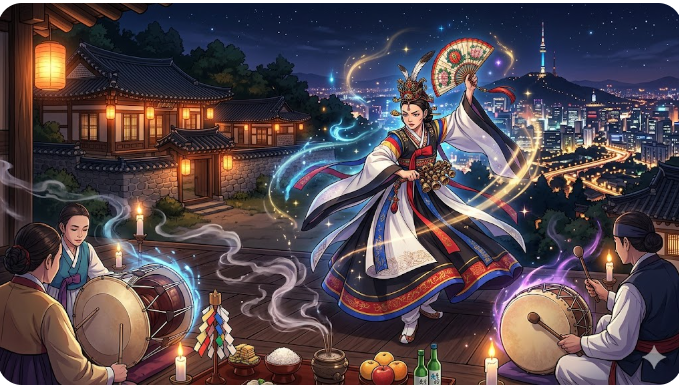
From Mudang to HUNTR/X, Here Is the Complete Guide to the Real Korean Mythology in the Film
This article was first published on April 13, 2026, and last updated on April 17, 2026.
Immigration policies and cultural regulations may change. Always confirm the latest details through official government websites and certified institutions.
Cover image credit: Image generated by AI (Gemini, 2026). AI-generated images are strictly for editorial purposes only, comply with free commercial-use licenses (Unsplash, Pixabay, Pexels), and are not permitted for resale or standalone commercial use. Images do not depict actual people, places, or events.
Editorial & AI Assistance Notice: This article was prepared by HACKsKorea editors with AI assistance (Claude). All facts were verified against official government and institutional sources. This is general information only, not legal advice. Users must confirm the latest details through official government websites or authorized agencies.
Travel & Culture Notice: This travel and cultural information is for general reference only and does not guarantee safety, accessibility, or current availability of destinations, services, or events. Travel conditions, entry requirements, and safety situations can change rapidly. Always check official sources and prioritize personal safety when traveling.
Summary at a Glance
K-pop Demon Hunters is, on its surface, a film about three young women who fight demons between sold-out stadium performances. But the moment you scratch beneath that brilliant, neon-lit surface, you find something far older and far stranger: a spiritual tradition that has survived the rise and fall of dynasties, the suppression of colonial occupation, the bulldozers of modernization campaigns, and the suspicion of a thoroughly digital twenty-first century.
Korean shamanism — known in Korean as musok (무속) or musok sinang (무속신앙) — is the indigenous spiritual tradition of the Korean peninsula. It predates Buddhism, which arrived from China in the fourth century CE. It predates Confucianism, which became the governing ideology of the Joseon Dynasty (조선왕조, 1392 to 1897). It predates Christianity, which gained significant influence from the late nineteenth century onward. And unlike many of those traditions, it never organized itself into a hierarchy, a scripture, or a set of fixed doctrines. It simply survived, flowing underground through the communities that needed it.
At its center stands the mudang (무당) — a female spiritual intermediary who serves as a bridge between the living and the dead, between the human world and the spirit realm. The mudang does not simply pray or meditate. She performs. She drums, chants, dances, weeps, and laughs. She wears elaborate costumes that identify specific deities. She climbs onto the blades of swords as proof of divine protection. And through all of this performance — this explosion of sound and color and physical commitment — she channels the unresolved grief, longing, and suffering of her community into something that can be felt, witnessed, and released.
This is exactly what HUNTR/X (헌트릭스) does in K-pop Demon Hunters. Their performances are not merely concerts. They are gut ceremonies (굿) — ancient shamanic rituals — translated into the language of modern idol culture. Their music does not just entertain. It creates a protective barrier between the human world and the forces of darkness that would consume it.
This guide is the second installment of the HACKsKorea K-pop Demon Hunters series. Where Part One covered the film as a whole, this volume goes deeper — into the spiritual architecture that makes the film extraordinary. You will find here a detailed exploration of the mudang tradition, the mythology of the Jeoseung Saja (저승사자), the visual language of Korean folk art, and the physical places in Korea where these traditions remain alive today. Estimated reading time is approximately thirty-five minutes.
Who This Guide Is For and What You Need to Know
This deep dive into Korean shamanism and its connection to K-pop Demon Hunters is designed to be genuinely useful across a wide range of readers, each bringing a different starting point and a different set of questions.
Foreign residents living in Korea will find here a framework for understanding the spiritual geography of the country they inhabit. You have likely encountered the sound of gut drums in a residential neighborhood and wondered what was happening behind a closed door. You have probably walked past shamanic shrines on a mountainside hike without fully understanding what you were seeing. This guide places those experiences in a context that makes them legible and meaningful.
International K-pop fans who encountered Korean culture through the film will find here the historical and anthropological roots of what they witnessed on screen. The choreography of HUNTR/X is not merely athletic. It echoes specific movements from mudang ritual practice. The color palette of their stage costumes is not arbitrary. It follows the ancient Korean color system known as obangsaek (오방색). This guide explains what those connections mean and why they matter.
Cultural travelers planning a visit to Korea inspired by the film will find here a practical roadmap for moving from the animated version of Korea to the real one. Every shamanic tradition mentioned in this guide has a physical counterpart somewhere in Korea — a mountain shrine, a museum, a heritage center, a neighborhood — that can be visited by anyone who arrives with curiosity and respect.
Students of world mythology, folklore, and comparative religion will find here a case study in how ancient spiritual traditions survive and transform. Korean shamanism has been suppressed by Confucian elites, criminalized by colonial authorities, bulldozed by modernization campaigns, and marginalized by rapid industrialization. And yet, according to research published in the journal Religions in 2025, more than 50,000 shamanic rituals are still performed annually in and around Seoul alone. Approximately 150,000 to 200,000 practicing mudang remain active across South Korea today. This is a tradition that refuses to disappear.
One critical note before proceeding: everything in this guide treats Korean shamanism as a living practice, not a historical curiosity. The mudang you might encounter on Inwangsan Mountain (인왕산) in Seoul is not a performer staging a cultural experience for tourists. She is a working spiritual professional, serving real clients who are navigating real grief, real fear, and real hope. Approaching the tradition with that understanding is the foundation of genuine cultural engagement.
Step-by-Step Guide to Understanding Korean Shamanism Through KPDH
Step 1: Understand Who the Mudang Really Is (무당의 본질 이해하기)
- Estimated time: 30 minutes
- What you need: Internet access, a quiet space for reading
- 💡 Pro Tip: Search for documentary footage of actual gut ceremonies before watching the film again. The difference between knowing about mudang and seeing one perform will transform your understanding of every HUNTR/X concert sequence.
The mudang (무당) is the most misunderstood figure in Korean spiritual tradition. In popular Western imagination, she is often reduced to a fortune-teller or a witch doctor — a colorful curiosity at the margins of a more serious religion. This understanding is precisely wrong.
The mudang is, first and foremost, a community mediator. She stands between the living and the dead, between the bereaved and their lost loved ones, between a family facing crisis and the spiritual forces that might resolve it. Her primary function is not prediction but negotiation — and her primary tool is not mysticism but performance.
There are two distinct types of mudang in Korea, defined by how they came to their vocation. The kangshinmu (강신무) — also written as gangshinmu — receives her calling through direct spiritual possession. She experiences what is called sinbyeong (신병), a condition of profound physical and psychological suffering that shamanic tradition interprets as the spirits forcibly claiming their chosen intermediary. The symptoms of sinbyeong can include severe illness, vivid visions, inexplicable behavioral changes, and an inability to function normally in daily life. The suffering continues until the person accepts her calling and undergoes a formal initiation ceremony called the naerim gut (내림굿). This type of mudang is more common in the central and northern regions of Korea.
The sesseupmu (세습무), by contrast, inherits the role through family lineage. Her calling is determined by birth rather than by spiritual possession, and her training is transmitted through direct apprenticeship within the shamanic family tradition. This type of mudang is more common in the southern regions of Korea.
In K-pop Demon Hunters, Rumi’s experience mirrors the kangshinmu path with remarkable precision. Her dark mark — the visible evidence of supernatural lineage — is the film’s version of sinbyeong. Her entire arc is the story of a person who has been claimed by forces beyond her control, who suffers under the weight of that claiming, and who eventually discovers that acceptance of her true nature is the only path to both personal peace and collective protection. Director Maggie Kang has confirmed that sinbyeong was a deliberate inspiration for this element of the story.
⚠️ Note: Sinbyeong is a genuine and serious concept within Korean shamanic tradition, describing real experiences of suffering and spiritual crisis. It should not be treated as metaphor or dramatic device when discussing the tradition itself. The film uses it as creative inspiration; the lived experience of those who undergo it is distinct.
Step 2: Decode the Gut Ceremony Hidden Inside Every HUNTR/X Concert (굿 의식 해독하기)
- Estimated time: 90 minutes (during a film re-watch)
- What you need: Netflix access, knowledge of the five elements of a gut ceremony
- 💡 Pro Tip: Watch the opening stadium sequence with the sound off first, then with sound. The visual structure of the performance — costume, movement, spatial arrangement — tells its own story independent of the music.
The gut (굿) is the central ritual of Korean shamanism. It is not a quiet ceremony. It is not a meditative practice. A gut is loud, physical, visually overwhelming, and deliberately designed to create a liminal space — a threshold condition in which the boundaries between the human world and the spirit world become permeable.
A gut consists of a series of ritual sections called geori (거리). In each geori, the mudang calls upon a specific deity or ancestral spirit, dresses in the colors and costume associated with that spirit, and performs the movements and songs through which that spirit speaks to the gathered community. A full gut ceremony can last from several hours to multiple days, with the mudang cycling through dozens of costumes and dozens of spirits in succession. The drumming — provided by the accompanying ritual musician called the jaengyi (재비) or aksa (악사) — never stops for long. It is the heartbeat of the ritual.
Every HUNTR/X concert in K-pop Demon Hunters follows this same architecture. Each performance section corresponds to a different energy — different movement quality, different color palette, different emotional register. The transitions between sections mirror the costume changes between geori. The relationship between HUNTR/X and their musicians echoes the relationship between mudang and jaengyi (재비). Even the spatial arrangement of the stage — with the performers elevated above the gathered crowd — recalls the traditional placement of the mudang at the center of the ritual space, visible to all who need her.
The film’s most explicit reference to the gut structure is the sword scene. In traditional shamanic practice, a mudang demonstrates divine protection and spiritual authority by standing barefoot on the blades of stacked swords — a practice called jakdu (작두). The capacity to do this without injury is understood as proof that the spirits are present and working through her. The film’s equivalent is every moment when HUNTR/X performs under conditions that would destroy anyone not protected by spiritual power.
The obangsaek (오방색) — the system of five directional colors fundamental to Korean cosmology — governs the visual language of gut costumes and is directly reflected in HUNTR/X’s stage wardrobe. White corresponds to the west and the realm of the dead. Black corresponds to the north and the water element. Blue corresponds to the east and new beginnings. Red corresponds to the south and fire, passion, and protective force. Yellow corresponds to the center and the earth. Notice which color HUNTR/X is wearing in each major sequence of the film and consider what spiritual register that color represents.
⚠️ Note: The obangsaek system is more complex and nuanced than a simple color-meaning correspondence chart suggests. Colors interact with one another, with specific deities, and with the specific purposes of each ritual. This guide provides an introduction, not a complete analysis.
Step 3: Understand the Jeoseung Saja Who Became the Saja Boys (저승사자 신화 이해하기)
- Estimated time: 30 minutes
- What you need: Basic familiarity with the film’s villain group
- 💡 Pro Tip: Think of the Jeoseung Saja not as the Korean equivalent of the Western Grim Reaper but as a divine civil servant — a spirit bureaucrat whose job is paperwork and escort, not judgment or punishment.
The Saja Boys (사자 보이즈) are the film’s most brilliant creative inversion, and understanding what they are actually based on transforms the entire story.
The Jeoseung Saja (저승사자) are the spirit messengers of the underworld in Korean folklore and religious tradition. The word saja (사자) means lion in modern Korean, but in this spiritual context it refers to a messenger or envoy. The jeoseung (저승) is the underworld — the realm of the dead. A jeoseung saja is therefore an underworld messenger: a figure dispatched from the realm of the dead to collect the soul of a person whose time in the living world has ended.
In traditional Korean shamanic belief, the jeoseung saja were not frightening figures in the way that Western images of death tend to be. They were bureaucratic ones. They carried official documents from the spirit world. They appeared at the moment of death wearing the formal black robes and wide-brimmed hats of Joseon Dynasty (조선왕조) officials. They presented their credentials. And they escorted the newly dead soul on its journey to the underworld with a kind of professional neutrality — neither cruel nor kind, simply efficient. They were doing their job.
The gut ritual known as the jinogwi gut (진오귀굿) — the soul-guiding ceremony performed to help a recently deceased person navigate safely to the afterlife — includes a section in which the mudang calls upon the jeoseung saja and negotiates with them on behalf of the deceased. She might ask them to wait a little longer, to treat the soul gently, to allow the person one last communication with their family. The saja, being bureaucrats, can sometimes be persuaded.
The Saja Boys invert this mythology with precision. Instead of neutral escorts performing a cosmic function, they are active predators — draining life energy from fans to serve a demonic agenda. Instead of wearing the formal robes of official duty, they wear the coordinated stage costumes of an idol group, using charm and performance as their weapons. The film explicitly frames this as a corruption of the original function: something that was supposed to be neutral and cosmic has been weaponized in service of manufactured destruction.
The contrast between the traditional jeoseung saja and the film’s Saja Boys is the film’s central moral argument. Authenticity — even when frightening, even when painful — is generative. Artificial perfection, manufactured to maximize appeal and minimize genuine content, is predatory.
⚠️ Note: The jeoseung saja mythology is still taken seriously by many Koreans, particularly in the context of grief and the rituals surrounding death. Treating it purely as folklore material for a film analysis, while appropriate in this context, misses its genuine significance in the lives of people for whom the tradition remains spiritually meaningful.
Step 4: Explore the Minhwa Folk Art Behind the Magpie and Tiger (민화 속 까치와 호랑이 탐구하기)
- Estimated time: 60 minutes
- What you need: Access to the National Museum of Korea website or, ideally, a visit in person
- 💡 Pro Tip: The National Museum of Korea (국립중앙박물관) maintains a digital collection accessible in English. Search for minhwa in the collection database before visiting to identify specific works you want to see in person.
The magpie (까치, kkachi) and tiger (호랑이, horangi) characters in K-pop Demon Hunters are not original creations. They are drawn directly from one of Korea’s most beloved folk painting traditions — a genre called minhwa (민화), which flourished primarily during the Joseon Dynasty and continued into the early twentieth century.
Minhwa translates approximately as people’s painting or folk painting. Unlike the formal court art produced by trained professional painters for aristocratic patrons, minhwa was produced by ordinary artists for ordinary households. Its purposes were protective and auspicious rather than decorative — images were chosen and displayed not because they were beautiful, though many of them are, but because of what they were believed to do for the household that owned them.
The kkachihorangi (까치호랑이) — the magpie-and-tiger composition — is among the most iconic of all minhwa subjects. In traditional Korean shamanic belief, the tiger was a mountain spirit, a guardian of sacred space, and a force capable of driving away malevolent energies. Despite its fearsome power, the minhwa tiger is almost never depicted as threatening. Instead, it wears an expression that Korean art historians consistently describe as goofy, endearing, or even slightly confused — a powerful guardian who is also, somehow, approachable. The magpie, meanwhile, is the herald of good news, the bird who announces that something worth celebrating is approaching.
In the characteristic kkachihorangi composition, the magpie perches above the tiger, often appearing to deliver or receive a message. The two animals look at each other with an air of mutual recognition. The image communicates something essentially optimistic about the relationship between power and communication, between protection and news, between the fierce and the tender.
The film’s characters draw on this tradition with evident care. The tiger character — loyal, physically formidable, slightly ridiculous, fiercely devoted — is the minhwa tiger brought into animated form. The magpie — quick, communicative, slightly superior in manner, always arriving with information — is the minhwa kkachi. Their presence in the film is not merely decorative. They are the film’s most direct visual connection to the pre-modern Korean spiritual world.
⚠️ Note: Minhwa is a living tradition with contemporary practitioners as well as historical examples. When purchasing minhwa-inspired goods in Korea, consider whether the item supports a contemporary Korean artist working within the tradition. Insadong (인사동) neighborhood in Seoul has numerous galleries and shops where contemporary minhwa artists sell original work.
Step 5: Plan Your Shamanic Heritage Route in Korea (무속 문화유산 탐방 계획 세우기)
- Estimated time: 1 full day minimum per location
- What you need: T-money card (티머니 카드), comfortable walking shoes, advance reservations where noted
- 💡 Pro Tip: The National Intangible Heritage Center (국립무형유산원) in Jeonju (전주) schedules public demonstration performances of designated intangible heritage traditions throughout the year. Check their English-language website for current schedules before planning your trip.
The physical world of Korean shamanism is accessible to any visitor who arrives with genuine curiosity and basic respect. What follows is a practical route for experiencing the real counterparts of what K-pop Demon Hunters depicts on screen.
Inwangsan Mountain (인왕산) in Seoul is the most accessible site for experiencing the living shamanic tradition in the capital. The mountain, located in Jongno-gu (종로구), has been one of Seoul’s primary shamanic sacred sites for centuries. Its rocky slopes contain numerous small shrines — some modest cairns with incense, others elaborate painted altars maintained by resident mudang. Arriving early in the morning significantly increases the likelihood of witnessing an active ritual in progress. The mountain is accessible from Dongnimmun Station (독립문역) on Seoul Subway Line 3 (지하철 3호선). Hiking time to the summit is approximately forty-five minutes on moderate terrain.
The National Folk Museum of Korea (국립민속박물관), located within the grounds of Gyeongbokgung Palace (경복궁) in central Seoul, maintains permanent exhibitions on Korean shamanism and folk religion. English-language audio guides are available. The museum’s courtyard contains examples of jangseung (장승) — the carved wooden guardian poles traditionally placed at village entrances to protect the community from malevolent spirits. Admission is free for the permanent collection.
The National Intangible Heritage Center (국립무형유산원) in Jeonju (전주), North Jeolla Province (전라북도), is the primary national institution for preserving and transmitting Korea’s designated intangible heritage. The center hosts live performance demonstrations of traditional gut ceremonies on a regular basis, presented in educational contexts that are accessible to international visitors. Jeonju is approximately two hours from Seoul by KTX (한국고속철도) high-speed rail from Seoul Station (서울역).
For those traveling to Jeju Island (제주도), the Chilmeoridang Shrine (칠머리당) in Jeju City (제주시) is the site of the Jeju Chilmeoridang Yeongdeunggut (칠머리당영등굿) — a shamanic ceremony inscribed on UNESCO’s Representative List of the Intangible Cultural Heritage of Humanity in 2009. The ceremony is traditionally performed in the first lunar month each year to pray for calm seas and abundant harvests. The Korea Tourism Organization (한국관광공사) website provides current scheduling and visitor information.
⚠️ Note: Shamanic rituals on Inwangsan and at other active shrines are not tourist performances. They are genuine religious ceremonies being conducted for real clients. Observing from a respectful distance is appropriate. Photographing, filming, or approaching the mudang or her clients without explicit permission is not.
Regional Differences in Korean Shamanic Tradition
Korean shamanism is not a single uniform practice. It is a family of regional traditions, each shaped by the geography, history, and community life of its home territory. Understanding these regional differences adds substantial depth to how K-pop Demon Hunters can be read — and to any visit to Korea inspired by the film.
Seoul and Gyeonggi-do (서울 및 경기도) — The Theatrical Urban Tradition
The shamanic tradition of the capital region is known for its spectacular theatrical quality. The Seoul gut (서울굿) — also called the gyeonggi gut (경기굿) — is performed by kangshinmu, the possession-type shaman whose calling comes through sinbyeong. The rituals of this tradition are known for elaborate costume changes, vibrant color, rapid transitions between deities, and a performance energy that is intense, athletic, and emotionally expansive. Because the capital was historically the center of royal and aristocratic society, the Seoul tradition developed a particularly sophisticated visual and performative vocabulary — one designed to be seen, to be witnessed, to make an impression.
This is the tradition that K-pop Demon Hunters draws from most directly. The high-energy stadium performances of HUNTR/X — the costume changes that happen between songs, the different emotional registers of different performance sequences, the physical intensity of the choreography — all echo the specific character of Seoul-region gut practice. In a sense, the film suggests that K-pop is what happens when the Seoul gut goes global.
Gyeonggi-do and South Chungcheong Province (경기도 및 충청남도) — The Interstitial Zone
In the provinces surrounding Seoul, shamanic practice blends the urban theatrical tradition of the capital with the more earthly, community-rooted traditions of the countryside. Villages in this region maintained sansin je (산신제) — mountain spirit ceremonies — that connected the community to the guardian spirit of the local mountain range. These ceremonies were less spectacular than the Seoul gut and more intimate — smaller gatherings, simpler costumes, a closer relationship between the shaman and the specific community she served. They served as the emotional infrastructure of village life, marking agricultural cycles, managing communal grief, and maintaining the relationship between the community and the spirits that inhabited its landscape.
Gyeongsang-do (경상도) — The Southern Heritage Tradition
In the southeastern provinces of North Gyeongsang (경상북도) and South Gyeongsang (경상남도), the sesseupmu tradition — hereditary shamanism — remains particularly strong. Here, the role of the mudang passes from mother to daughter or from teacher to designated successor, transmitted through lineage and apprenticeship rather than through spiritual possession. Andong (안동), one of the most historically significant cities of traditional Korean Confucian culture, is also home to the Andong Hahoe Mask Dance (안동 하회별신굿탈놀이) — a UNESCO Intangible Cultural Heritage that combines shamanic ritual function with the theatrical tradition of mask performance. The Hahoe masks, which date to the Goryeo Dynasty (고려왕조, 918 to 1392), are among the oldest surviving objects in Korean performance history.
Jeju Island (제주도) — The Maritime World
Jeju’s shamanic tradition is the most distinct of all Korean regional variants, shaped by the island’s isolation, its seafaring culture, and its unique relationship with the surrounding ocean. Jeju is sometimes called the Island of 18,000 Gods (만 팔천 신들의 섬) — a reference to the extraordinary number of deities recognized within the local tradition, most of them tied to specific natural features, specific communities, or specific aspects of maritime life.
The Jeju mudang — called simbang (심방) in the local dialect — serves a community whose livelihood has historically depended on the sea. The rituals of the Jeju tradition are therefore deeply concerned with the relationship between the living and the ocean: prayers for safe voyages, ceremonies for fishermen who did not return, rituals to honor the haenyeo (해녀) divers who harvest the waters around the island.
The Jeju Chilmeoridang Yeongdeunggut (칠머리당영등굿), inscribed on UNESCO’s Representative List in 2009, is performed annually at the Chilmeoridang Shrine in Jeju City to welcome the spring wind goddess Yeongdeung (영등) and pray for abundant seas. If K-pop Demon Hunters were set on Jeju rather than Seoul, its HUNTR/X would be fighting ocean demons rather than urban ones — and their protective music would sound very different.
Thomas, a French Philosophy Student Who Found Han in a Gut Ceremony
(The following is a fictionalized scenario created for educational purposes. It does not describe any real person, event, or case.)
Thomas had been studying at a university in Sinchon (신촌), Seoul, for one semester when a Korean classmate invited him to observe a gut ceremony being held for her grandmother’s memorial. Thomas had arrived in Korea with a strong academic background in Western philosophy and phenomenology but almost no knowledge of Korean spiritual tradition. He accepted the invitation with the detachment of a curious observer.
What he encountered was not what he expected. He had anticipated something quiet and solemn — a ceremony resembling the religious rituals he knew from European contexts. Instead, he found himself in a living room transformed into a ritual space, surrounded by food offerings stacked on tables, the smell of incense, and the sound of a janggu drum that seemed to enter his chest rather than merely his ears. The mudang moved between costumes, her voice shifting between registers that ranged from low and commanding to high and keening, and Thomas found himself unexpectedly moved in a way that his philosophical training offered no framework to process.
He later described the experience as his first encounter with what Koreans call han (한) — the collective emotional weight of unresolved grief that the gut ceremony is designed to give voice to and, through that voicing, to release. Han is not depression. It is not simply sadness. It is something closer to the accumulated sorrow of a people who have endured extraordinary suffering across centuries and who have learned to transform that sorrow through communal performance rather than suppress it through individual stoicism.
Thomas wrote his semester dissertation on the relationship between han and what Western philosophers call catharsis. His advisor submitted the paper to an international journal of cultural philosophy, where it was accepted for publication. Thomas returned to France having fundamentally revised his understanding of what philosophy could look like when it grew from a different soil.
When he rewatched K-pop Demon Hunters after returning home, he understood the film’s emotional architecture in a completely different way. HUNTR/X’s music is not merely entertaining. It is the mechanism through which han is processed and released. Their concerts are communal gut ceremonies for a generation that may never have attended an actual one.
Key Lesson: Genuine encounter with a living spiritual tradition can transform intellectual understanding into embodied knowledge. For foreign students studying in Korea, accepting invitations to observe real cultural and spiritual events — approached with respect and humility — creates educational experiences that no classroom can replicate.
Mei, a Taiwanese Designer Who Built a Collection Around Obangsaek
(The following is a fictionalized scenario created for educational purposes. It does not describe any real person, event, or case.)
Mei had been working as a textile designer in Taipei for seven years when K-pop Demon Hunters was released on Netflix. She watched it on a Thursday evening expecting a pleasant distraction and found herself pausing the film repeatedly to sketch costume details. The color system governing HUNTR/X’s stage wardrobe — its precise, purposeful distribution of white, black, blue, red, and yellow across different performance sequences — struck her trained eye immediately as something more systematic than ordinary art direction.
She began researching obangsaek (오방색) — the Korean five-directional color system rooted in cosmological tradition — and discovered that the colors she had been admiring on screen were the same colors that had governed Korean craft, ritual, and architectural decoration for centuries. Each color corresponded to a cardinal direction, an element, a season, and a set of symbolic meanings. Together they described a complete cosmological map, encoded in pigment.
Mei applied for and received a three-month residency at a traditional craft center in Jeonju (전주), the city in North Jeolla Province (전라북도) famous for its preserved hanok village and its deep traditions of paper, lacquerware, and textile craft. During her residency, she worked alongside Korean craftspeople who had been working with traditional color systems for decades, learning not just the visual appearance of the five colors but the specific natural dyes and materials through which they were traditionally achieved.
The collection she produced at the end of her residency — a series of garments and textile installations built on the obangsaek system — was exhibited at a gallery in Seoul’s Insadong (인사동) neighborhood. The exhibition drew attention from both Korean craft communities and international fashion media. Mei described the collection publicly as an attempt to understand color not as decoration but as meaning — a concept she had encountered in K-pop Demon Hunters and traced back to its source.
She later spent a day at the National Folk Museum of Korea (국립민속박물관) studying historical examples of mudang robes and ceremonial costumes. The precision with which specific colors were used in specific ritual contexts confirmed for her that the film’s costume department had done their research seriously.
Key Lesson: Korean traditional arts contain sophisticated intellectual systems that reward sustained study. For designers, artists, and craftspeople inspired by Korean aesthetics, engaging directly with the traditional knowledge systems behind those aesthetics opens creative possibilities that surface-level imitation cannot access.
Daniel, a Nigerian Graduate Student Who Connected Shamanism to Ancestral Spirit Traditions
(The following is a fictionalized scenario created for educational purposes. It does not describe any real person, event, or case.)
Daniel was completing a doctorate in comparative religion at a university in Lagos when K-pop Demon Hunters became a global conversation. He watched it specifically because a colleague had mentioned its engagement with Korean shamanic tradition, and he was immediately struck by structural parallels with the Yoruba spiritual traditions he had spent his academic career studying.
In both traditions, he observed, there exist specialist figures — called mudang in Korea, babalawos and iyanifas in Yoruba tradition — who serve as intermediaries between the living and the dead. In both traditions, these specialists undergo a form of calling or initiation that involves a period of suffering or crisis. In both traditions, the primary tool of spiritual intervention is performance — music, dance, costume, and the creation of a ritual space in which the boundaries between the human world and the spirit world become temporarily permeable. In both traditions, the community gathers not as passive witnesses but as active participants in the ritual work being done.
Daniel contacted a Korean studies professor at a partner institution in Seoul and proposed a comparative research project examining the structural parallels between Korean musok and West African spirit mediation traditions. The proposal was funded through a joint grant from the Korean Foundation for International Cultural Exchange (한국국제문화교류진흥원) and an international humanities research body.
He spent three months in Korea, attending public demonstrations of gut ceremonies at the National Intangible Heritage Center (국립무형유산원) in Jeonju, interviewing scholars of Korean shamanism at several Seoul universities, and visiting the shamanic shrine district on Inwangsan Mountain (인왕산) in Seoul. He was careful throughout to approach Korean shamanism as a colleague approaching a peer tradition — with the same scholarly respect he would extend to any serious subject of study.
His completed paper, published in a peer-reviewed journal of comparative religion, argued that the global resonance of K-pop Demon Hunters could be partially explained by its activation of spiritual archetypes that appear across many of the world’s indigenous and folk traditions — archetypes so widespread that audiences from widely divergent cultural backgrounds found themselves recognizing something in the film without being able to fully articulate what.
Key Lesson: Korean spiritual tradition participates in a global conversation about the human relationship with the unseen world. For scholars of world religion, mythology, and anthropology, Korean shamanism offers a particularly well-documented and still-living case study in how ancient practices survive and transform.
Anna, a Polish Teacher Living in Busan Who Finally Understood Her Neighborhood
(The following is a fictionalized scenario created for educational purposes. It does not describe any real person, event, or case.)
Anna had lived in Busan (부산) for four years, teaching English at a middle school in Haeundae-gu (해운대구), before she watched K-pop Demon Hunters. She liked her neighborhood. She liked the fish market, the proximity to the sea, the particular light of the city in the late afternoon. But she had always felt a mild, persistent puzzlement about certain things she encountered regularly and could not fully explain.
There was the small shrine near the entrance to her apartment building — a wooden shelf with offerings of fruit and rice wine that were refreshed periodically by someone she had never identified. There was the sound that sometimes drifted from a building several streets away on certain evenings — drumming that seemed to come from no particular direction and lasted for unpredictable durations. There was the painted image she passed on her morning walk, on the side of an old building at the edge of the neighborhood, of a tiger sitting under a pine tree with an expression that she could only describe as benevolent.
After watching K-pop Demon Hunters and spending several days reading about Korean shamanism, Anna understood all three of these things for the first time. The shrine near her building was a household altar for a domestic spirit — one of the many house deities (가신, gasin) of Korean folk tradition, whose care was the responsibility of the household that maintained the altar. The drumming was almost certainly a gut ceremony being performed in a nearby home. The tiger was a minhwa (민화) folk painting, a protective image placed there by a previous resident who wanted the good fortune the tiger was believed to bring.
Anna began attending public lectures on Korean folk religion at the Busan Museum (부산박물관). She started a blog in Polish about Korean spiritual culture, aimed at other Polish teachers living and working in Korea. The blog attracted a following significant enough that a Polish travel publication contacted her about writing a regular column on cultural life in Korea.
Key Lesson: Understanding the spiritual geography of the place you live transforms casual habitation into genuine residency. For foreigners living in Korean cities, the invisible layer of shamanic tradition embedded in the built environment becomes visible — and enriching — once you know what you are looking at.
Kenji, a Japanese Documentary Filmmaker Who Found His Next Project
(The following is a fictionalized scenario created for educational purposes. It does not describe any real person, event, or case.)
Kenji had been making documentary films about traditional music for twelve years — projects on Okinawan folk music, the shakuhachi tradition, and the preservation of Ainu song — when K-pop Demon Hunters prompted him to turn his attention to Korea. He was specifically interested in the film’s depiction of music as a form of spiritual protection: the idea that organized sound, performed by trained practitioners in specific contexts, could create and maintain a barrier between the human world and forces that would harm it.
He traveled to Korea for three months, spending the first month in Seoul attending public demonstrations of gut ceremonies and speaking with mudang willing to discuss their traditions for documentary purposes. He spent the second month in the rural areas of Gyeonggi Province (경기도), documenting smaller community-based shamanic ceremonies that received no media attention and served only the local communities for which they were performed. He spent the third month on Jeju Island (제주도), where he focused on the maritime shamanic tradition and its relationship to the lives of the haenyeo (해녀) — the women divers of Jeju whose communal culture and fishing practices are themselves a UNESCO Intangible Cultural Heritage.
What struck Kenji most deeply across all three locations was the relationship between music and community — the way in which shamanic performance in Korea created and maintained social bonds as much as it addressed spiritual concerns. The gut ceremony, he observed, was not primarily a transaction between one person and the spirits on their behalf. It was a community event in which the gathering itself — the shared witnessing, the shared food, the shared emotional experience — was as important as the ritual action.
He completed a documentary that traced the line from traditional gut ceremony music through the rhythmic foundations of Korean traditional music (국악, gugak) to the high-energy percussion that underlies contemporary K-pop production. The film argued that what audiences around the world were responding to in songs like “Golden” was, at some deep level, the heung (흥) — the explosive communal energy — that has been at the heart of Korean performance since before the word K-pop existed.
Key Lesson: The musical traditions of Korean shamanism represent a living lineage that connects directly to contemporary Korean popular music. For musicians, filmmakers, and music scholars, the acoustic and rhythmic vocabulary of the gut ceremony is an underexplored source of genuine creative and intellectual depth.
Sofia, a Brazilian University Student Who Planned Her First Trip to Korea
(The following is a fictionalized scenario created for educational purposes. It does not describe any real person, event, or case.)
Sofia had been a devoted K-pop fan since the age of fifteen, when she discovered BTS (방탄소년단) through a friend’s social media post. By the time K-pop Demon Hunters was released, she was twenty-two, studying communications at a university in São Paulo, and deeply familiar with the surface culture of Korean popular music — the fandoms, the choreography, the merchandise, the lightstick culture, the rhythms of album and concert cycles.
K-pop Demon Hunters prompted her to look at what lay beneath that surface for the first time. She began reading about Korean shamanism. She found the National Folk Museum of Korea’s English-language online resources. She watched documentary footage of gut ceremonies and was struck by how directly the performance energy she recognized from K-pop concerts — the physicality, the costume changes, the relationship between performer and gathered crowd, the sense of something at stake that went beyond mere entertainment — echoed what she saw in shamanic ritual.
Sofia began planning a trip to Korea. She built an itinerary that balanced the K-pop experiences she had dreamed of for years — attending a music show recording, visiting artist management company buildings in Apgujeong (압구정), shopping for albums and merchandise in Myeong-dong (명동) — with the shamanic heritage sites she had identified through her research. She planned a morning hike on Inwangsan Mountain (인왕산), a visit to the National Folk Museum, and a day trip to Jeonju (전주) to see the Intangible Heritage Center.
The trip she eventually took was, in her own words, the most educational week of her life. The K-pop experiences she had dreamed of were everything she hoped for. But the morning on Inwangsan, when she sat at a respectful distance from a small shrine while the sound of a mudang’s chanting drifted down from higher on the mountain, was something she could not have anticipated from a social media post or a fan account.
She came home and wrote a series of articles for a Brazilian K-pop fan community site that traced the shamanic roots of K-pop performance culture. The series was read by thousands of Brazilian K-pop fans who, like Sofia before her trip, had loved the surface without knowing the depth below it.
Key Lesson: K-pop fandom is one of the most powerful engines of genuine cultural curiosity in the world today. Fans who follow their interest in K-pop all the way back to its cultural and historical roots discover a depth that makes their connection to Korean culture richer, more informed, and more sustainable.
Ibrahim, a Moroccan Chef Who Found Korean Food Culture Through Shamanic Offering Tables
(The following is a fictionalized scenario created for educational purposes. It does not describe any real person, event, or case.)
Ibrahim was working as a head chef at a Korean restaurant in Casablanca when K-pop Demon Hunters was released. He had spent five years mastering Korean culinary technique but had always felt that his knowledge was technical rather than cultural — he could produce the food perfectly but did not fully understand the world from which it came.
The film’s gut ceremony sequences caught his attention specifically for the elaborate food offerings they depicted. He recognized the arrangement of the ritual table — the jesa (제사) offering table — as something he had seen referenced in cookbooks and recipe traditions without understanding its deeper context. He began researching the relationship between Korean food culture and shamanic practice.
What he found reshaped his understanding of Korean cuisine entirely. The traditional gut ceremony includes elaborate food preparation as an integral part of the ritual — specific foods for specific deities, arranged in precise ways that carry symbolic meaning. The seasonal foods used in shamanic offering tables correspond directly to the cycles of Korean agricultural life. Many of the dishes central to Korean festive and ceremonial cooking — the rice cakes called tteok (떡), the fermented foods that mark seasonal transitions, the specific arrangement of foods on an ancestral offering table — have deep roots in the shamanic tradition of maintaining right relationships with the spirits of the natural world.
Ibrahim traveled to Korea for a month-long culinary research trip, spending time in both Seoul and Jeonju. He visited the National Folk Museum of Korea (국립민속박물관) to study documentation of traditional ritual food preparation. He attended a public demonstration at the National Intangible Heritage Center (국립무형유산원) that included a presentation of gut offering table preparation. He spent time in traditional food markets in Gwangjang Market (광장시장) in Seoul and in the local markets of Jeonju, learning the seasonal and regional logic of Korean ingredient use.
He returned to Casablanca having fundamentally revised the philosophy underlying his restaurant’s approach to Korean food. The menu he redesigned after his return was built around seasonal cycles and the principle that food, at its most significant, is a form of communication — between the cook and the ingredients, between the diner and the tradition that produced the dish, and between the living and everything that preceded them.
Key Lesson: Korean food culture is inseparable from the spiritual traditions that shaped it. For culinary professionals working with Korean cuisine, understanding the shamanic and ceremonial dimensions of Korean food preparation adds a dimension of depth and meaning that transforms technical competence into cultural literacy.
Priya, an Indian Visual Artist Who Created a Cross-Cultural Installation
(The following is a fictionalized scenario created for educational purposes. It does not describe any real person, event, or case.)
Priya was a visual artist based in Mumbai whose work explored the visual languages of traditional spiritual practice across Asian cultures. She had previously created large-scale installations examining Buddhist iconography in Sri Lanka and Balinese temple art. K-pop Demon Hunters introduced her to Korean shamanism as a visual tradition she had not previously engaged with, and she was immediately struck by the sophistication and coherence of its visual vocabulary.
She was particularly drawn to the minhwa (민화) tradition — specifically the relationship between the folk painting tradition and the spiritual functions it served. The idea that a painting could be simultaneously an aesthetic object and a working protective device — that the image of a tiger on a wall was not merely decorative but functionally present, guarding the household against specific categories of misfortune — resonated deeply with her experience of similar traditions in South and Southeast Asian visual culture.
Priya applied for a residency at the Seoul Museum of Art (서울시립미술관) and was accepted for a three-month program. During her residency, she spent extensive time at the National Museum of Korea (국립중앙박물관) studying minhwa works in the permanent collection and spoke with Korean art historians and contemporary minhwa artists about the tradition’s history and current practice.
The installation she created at the end of her residency placed Korean minhwa imagery in direct visual conversation with corresponding protective art forms from the Indian subcontinent — specifically the Madhubani painting tradition of Bihar, in which similar principles of protective, auspicious imagery govern a vibrant folk painting practice. The installation covered three gallery walls, and visitors walked between the two traditions in a space that made their structural similarities — and their cultural distinctiveness — simultaneously visible.
Korean art critics praised the installation for the seriousness with which it treated minhwa as an intellectually significant tradition rather than a decorative one. Indian arts commentators wrote about it as evidence that the visual languages of Asian folk spiritual traditions constitute a genuine family of related practices deserving of comparative study. The installation traveled to three additional venues, including a gallery in Jeonju (전주) and one in New Delhi.
Key Lesson: Korean folk spiritual art participates in a global conversation about the relationship between visual form and spiritual function. For artists from other Asian traditions, engaging seriously with Korean minhwa creates productive cross-cultural dialogues that illuminate both traditions.
FAQ
1. Is Korean shamanism a religion, a cultural practice, or something else entirely?
Korean shamanism resists the categories that Western observers most commonly bring to it. In the formal sense of organized religion — ordained clergy, a fixed scripture, a defined creed — Korean shamanism has none of these. There is no central shamanic authority, no sacred texts, no formal membership. Individual mudang operate independently, serving the clients who seek them out without institutional structure.
In the anthropological sense of a belief system addressing the fundamental questions of human existence — why we suffer, what happens when we die — Korean shamanism is fully and seriously a religion. It has a cosmology, an ethics, and a theology: a rich understanding of divine beings, ancestral spirits, and natural forces that inhabit the cosmos and require relationship with human communities.
The most accurate description is that Korean shamanism is the indigenous folk religion of the Korean peninsula — a comprehensive spiritual system predating all the formal religions that arrived since, coexisting and blending with them over centuries, and remaining a living practice for hundreds of thousands of practitioners today.
For visitors to Korea, this means shamanism is not necessarily an alternative to Buddhism, Confucianism, or Christianity. Many Koreans who attend church on Sunday will also consult a mudang in times of crisis. The categories are porous in ways that Western frameworks do not always prepare visitors to understand.
2. What exactly happens during a gut ceremony, and how long does it last?
A gut (굿) ceremony is, at its most fundamental, a negotiation. The mudang creates a ritual space — defined by offerings, incense, music, and the presence of the gathered community — and then invites specific deities and ancestral spirits into that space. She speaks with them, on behalf of her clients, about the matters that have brought the community together: a business that needs protection, a family member whose soul needs guiding to the afterlife, a sick child, a grieving widow, a household beset by misfortune. She makes offerings, conveys messages, receives responses in the form of oracular speech delivered through her trance state, and eventually escorts the spirits back to their own realm.
Each section of a gut ceremony is called a geori (거리). A single geori might last twenty minutes or an hour. A full gut ceremony might contain twelve geori or thirty, depending on its purpose and the number of spirits being addressed. A simple gut for a specific purpose might be completed in a few hours. A major ceremony for an important occasion — a large family’s ancestral rite, a community ceremony before a significant undertaking, a memorial for someone who died in difficult circumstances — might continue for an entire day and night, or even longer.
The mudang performs the entire ceremony. This means she dances, chants, drums, speaks oracles, changes costumes, and maintains the ritual space without interruption for the duration. The physical demands of this work are considerable. A mudang performing a major gut will have prepared for days in advance through fasting, purification, and ritual preparation, and will typically spend several days in rest and recovery afterward.
Throughout the ceremony, the gathered community is not a passive audience. They participate by eating the ritual foods, by speaking with the mudang during appropriate moments, by responding to her oracular pronouncements, and by sharing in the collective emotional experience of the ritual. The Korean concept of heung (흥) — the explosive communal energy that rises through shared rhythm and shared experience — is generated by the gathered community as much as by the mudang herself. A gut without community is, in a meaningful sense, incomplete.
3. What is sinbyeong and why is it central to understanding Rumi’s character in the film?
Sinbyeong (신병) translates approximately as spirit sickness or divine illness — the condition that marks a person chosen by the spirits to become a mudang.
The symptoms can include prolonged physical illness with no identifiable medical cause, vivid and disturbing visions, inexplicable behavioral changes, acute psychological distress, and a persistent sense of being called toward something not yet understood. The tradition interprets these symptoms not as disease but as evidence that the spirits have made their choice and are pressing it upon the person with increasing intensity.
The crucial element is that sinbyeong resolves only through acceptance. When the person accepts her calling and undergoes the naerim gut (내림굿) initiation ceremony, the suffering lifts. It was not random — it was purposeful: the spirits making themselves impossible to ignore until their chosen intermediary agreed to serve.
Rumi’s experience in K-pop Demon Hunters follows this arc with remarkable fidelity. Her dark mark — visible evidence of supernatural lineage she has spent her life concealing — is the film’s equivalent of sinbyeong. Her suffering is not a plot complication. It is the condition of someone who has been claimed and is resisting the claiming. Her acceptance of the mark in the film’s climax is the naerim gut moment: suffering transforming into power.
Director Maggie Kang has confirmed that the sinbyeong concept was a deliberate inspiration for this element of the story.
4. Why does Korean shamanism portray the Grim Reaper so differently from Western traditions?
The Jeoseung Saja (저승사자) of Korean tradition and the Grim Reaper of Western imagination share a basic function — both are figures associated with death who escort the dead from the living world. But their character, their relationship to the living, and their moral valence could hardly be more different.
In Western tradition, the Grim Reaper is typically portrayed as a skeletal, robed figure carrying a scythe — an image of death as something that cuts down life indiscriminately and without relationship. The Grim Reaper is feared because death is feared. The figure carries no personality, no bureaucratic identity, no relationship to the specific circumstances of the person whose life it ends.
The Jeoseung Saja is a fundamentally different kind of figure. He is, first of all, a bureaucrat — a servant of the cosmic administrative system that governs the movement of souls between the living world and the realm of the dead. He carries official documents. He has a job to do and a system to follow. He is not the cause of death. He is its administrator.
More importantly, the Jeoseung Saja in Korean tradition is a figure who can be negotiated with. The mudang in a jinogwi gut ceremony — the soul-guiding ritual — will sometimes speak directly to the saja on behalf of a recently deceased person’s family, asking for gentleness, for patience, for the recognition of special circumstances. The saja, as a cosmic bureaucrat rather than a divine force of absolute judgment, can sometimes be moved. This makes him a figure in a relationship with the living, not merely an agent of their fear.
The Saja Boys’ inversion of this mythology is the film’s sharpest creative move. By transforming figures of neutral cosmic administration into active predators, the film argues implicitly that the danger of the modern entertainment industry lies precisely in this kind of inversion: the transformation of something that should serve the community into something that exploits it.
5. What is han and how does it connect both Korean shamanism and K-pop?
Han (한) is one of the most discussed concepts in Korean cultural life — an emotional register so specific to Korean experience that most translators conclude it cannot be adequately translated, only described.
The most common English approximation is accumulated grief or unresolved sorrow. But han is not simply sadness. It is something more like the emotional sediment that collects in a community over generations of endured suffering — the weight of wrongs never righted, losses never fully mourned, injustices never resolved. Han is collective as much as individual. A Korean person can carry han belonging not to their own experience but to their ancestors, their community, their nation.
Korean shamanism has, for centuries, served as a primary cultural mechanism for giving han voice and allowing partial release. The gut ceremony creates a structured space in which unresolved emotion can be expressed, witnessed, and transformed. The mudang speaks the unspeakable, gives voice to the dead, channels accumulated sorrow through her body and performance. The collective experience of this — shared weeping, shared recognition, shared catharsis — releases something held too long.
K-pop operates on a similar emotional principle. The idol industry at its best creates performers whose relationship with fans involves an emotional contract: the idol performs vulnerability and commitment, and the fan responds with devotion and shared feeling. When this works, it creates something close to the communal emotional release of the gut ceremony. Not incidentally, both use music, dance, costume, and the gathered crowd as their instruments.
6. How can I witness a genuine gut ceremony in Korea as a foreign visitor?
Witnessing a genuine gut ceremony in Korea requires a combination of fortunate timing, local connection, and genuine respect for what you are observing. There is no tourist package that delivers the experience on demand, and there should not be.
The most accessible route for foreign visitors is through the National Intangible Heritage Center (국립무형유산원) in Jeonju (전주), which regularly schedules public demonstration performances of designated intangible heritage traditions, including various forms of gut ceremony. These performances are presented in educational contexts and are designed to be accessible to general audiences, including international visitors. The center’s English-language website lists current and upcoming programs. Jeonju is approximately two hours from Seoul by KTX (한국고속철도) high-speed rail from Seoul Station (서울역), making it a practical day trip or overnight excursion.
The Gangneung Danoje Festival (강릉단오제), held annually in Gangneung (강릉), Gangwon Province (강원도), in May or June according to the lunar calendar, is a large-scale public festival centered on shamanic ritual and designated as a UNESCO Intangible Cultural Heritage. It includes public gut ceremony performances accessible to general visitors and provides an immersive context for understanding how shamanic tradition functions in relation to a specific community and its annual rhythms.
For visitors in Seoul, Inwangsan Mountain (인왕산) in Jongno-gu (종로구) offers the possibility of observing small-scale active ceremonies at the mountain’s shamanic shrines. No scheduling is possible for this — ceremonies happen when clients require them, not on a calendar accessible to visitors. But arriving on the mountain in the early morning, particularly on significant dates in the lunar calendar, significantly increases the probability of witnessing something. Observing from a respectful distance — not approaching the mudang or her clients, not photographing without explicit permission, speaking quietly if at all — is the appropriate conduct.
7. What is the relationship between Korean shamanism and Buddhism in Korea today?
The relationship between Korean shamanism and Buddhism is one of the most interesting examples of religious synthesis in Asian history. Rather than competing as incompatible alternatives, the two traditions have lived alongside each other in Korea for over fifteen centuries and have influenced each other in ways that make them, in practice, nearly impossible to fully separate.
Buddhism arrived in Korea from China in the fourth century CE and was adopted as the state religion during the Goryeo Dynasty (고려왕조, 918 to 1392). Its arrival did not displace shamanism but instead produced a process of synthesis — known in Korean scholarship as muobul seubhap (무불습합), the blending of shamanism and Buddhism — in which shamanic elements were absorbed into Buddhist practice and vice versa. The most visible evidence of this synthesis is the sansingak (산신각) — a small hall found at the back of virtually every Korean Buddhist temple, dedicated to the mountain spirit (산신, sansin), a figure drawn directly from the shamanic tradition. A Korean Buddhist temple is therefore simultaneously a Buddhist place of worship and a site of shamanic mountain spirit veneration, coexisting in the same physical space without apparent contradiction.
This synthesis reflects a broader characteristic of Korean religious life — a pragmatic inclusivity that allows different spiritual frameworks to coexist and complement each other rather than demanding exclusive allegiance. Many Koreans who identify as Buddhist will also consult a mudang in times of crisis. Many who identify as Christian will observe ancestral rites derived from the shamanic tradition. The boundaries between traditions are permeable in ways that Western concepts of religious identity struggle to accommodate.
For visitors to Korean Buddhist temples, recognizing the sansingak at the back of the temple compound — usually a smaller building than the main hall, often with a painting of a mountain spirit accompanied by a tiger — adds a layer of understanding to the temple visit that is not immediately apparent without context.
8. What are the most significant Korean shamanic sites I can visit outside of Seoul?
Korea’s shamanic heritage sites extend well beyond the capital, and several of the most significant and most accessible are found in cities and landscapes that reward broader travel.
Jeonju (전주) in North Jeolla Province (전라북도) is, as noted elsewhere in this guide, home to the National Intangible Heritage Center (국립무형유산원), which is the primary national institution for the preservation and transmission of designated intangible heritage traditions, including gut ceremony traditions from across Korea. Jeonju is also famous for its Hanok Village (전주한옥마을) — a neighborhood of several hundred preserved traditional Korean houses that provides the most extensive and well-maintained example of traditional Korean urban architecture accessible to visitors anywhere in the country.
Gangneung (강릉) in Gangwon Province (강원도) is the site of the Gangneung Danoje Festival (강릉단오제), a UNESCO-designated event combining shamanic ritual, mask dance, and communal celebration into one of Korea’s largest traditional cultural festivals. The city’s proximity to the eastern coast and the distinctive landscape of the Taebaek Mountains (태백산맥) gives it a natural environment strongly associated with mountain spirit veneration in the shamanic tradition.
Andong (안동) in North Gyeongsang Province (경상북도) is the heartland of Joseon Dynasty Confucian culture and also home to the Hahoe Folk Village (하회마을), a UNESCO World Heritage Site where the Andong Hahoe Mask Dance (안동 하회별신굿탈놀이) — a tradition combining shamanic ritual with theatrical performance — has been performed for centuries. The masks used in this tradition are designated National Treasures (국보) and are among the oldest surviving examples of Korean performing arts objects.
Jeju Island (제주도) offers the Chilmeoridang Shrine (칠머리당) and the surrounding context of Jeju’s distinctive shamanic tradition, including the culture of the haenyeo (해녀) divers whose communal life and spiritual practices are deeply intertwined. The Jeju Folk Village Museum (제주민속촌박물관) near Seogwipo (서귀포) provides a comprehensive introduction to traditional Jeju material culture, including the spiritual objects and architectural features of the local shamanic tradition.
9. What is the obangsaek and how does it appear in K-pop Demon Hunters?
Obangsaek (오방색) — the system of five directional colors — is one of the most fundamental organizational principles of traditional Korean cosmology and aesthetics. It reflects a worldview in which the universe is organized around five cardinal directions — north, south, east, west, and center — each associated with a color, an element, a season, an animal, and symbolic meanings.
White (흰색) corresponds to the west, autumn, and the white tiger — the color of mourning and the realm of the dead. Black (검정색) corresponds to the north, winter, and the black tortoise. Blue-green (청색) corresponds to the east, spring, and the blue dragon — associated with new beginnings and hope. Red (빨강색) corresponds to the south, summer, and the red phoenix — the most actively protective color, widely used in shamanic ritual to drive away malevolent energies. Yellow (노랑색) corresponds to the center and earth element, associated with sovereignty and the grounding force that holds the other four directions in balance.
In K-pop Demon Hunters, the obangsaek governs HUNTR/X’s visual language at a level of detail that rewards careful attention. Each significant shift in the dominant color of a sequence corresponds to a shift in the spiritual register of what HUNTR/X is doing — mourning, protecting, renewing, confronting, or stabilizing. Rewatching the film with this system in mind transforms its visual language from impressive spectacle into a legible spiritual text.
The system appears throughout traditional Korean decorative arts, architecture, and craft. For visitors to Korea, recognizing obangsaek in everyday environments creates a continuous thread connecting experience to a cosmological tradition thousands of years old.
10. Who was the real mudang Kim Keum-hwa, and why does she matter?
Kim Keum-hwa (김금화, 1931 to 2019) was one of the most celebrated mudang in modern Korean history and a central figure in the preservation and public recognition of Korean shamanic tradition. Her life story is documented in the 2014 documentary film Manshin (만신, literally meaning the ten thousand spirits or the spirit woman), directed by Park Chan-kyong (박찬경), and her legacy represents the transition of Korean shamanism from a tradition actively suppressed by modernizing governments to one recognized and celebrated as a core element of national cultural heritage.
Kim Keum-hwa was born in the Hwanghae Province (황해도) region, which is now part of North Korea. She experienced sinbyeong — the shamanic illness that marks a chosen mudang — in her early twenties and underwent the naerim gut initiation ceremony, accepting her calling as a mudang in the Seoul tradition. She practiced for over six decades, developing a reputation as one of the most skilled and spiritually powerful mudang of her generation.
In 1985, the South Korean government designated her as a holder of Important Intangible Cultural Property Number 82 (중요무형문화재 제82호) for the West Coast Gut tradition (서해안 배연신굿). This designation represented a formal reversal of the government policy that had previously sought to suppress shamanic practice as superstition, and it established a precedent for the recognition of mudang traditions as significant components of Korean cultural heritage.
Kim Keum-hwa’s career bridged the historical suppression of shamanism and its contemporary recognition as living heritage. She taught hundreds of students, maintained the ritual traditions of the Seoul-region gut, and advocated publicly for the respect and recognition of mudang as cultural practitioners. The film Manshin gives international audiences a direct window into her life and work and serves as an excellent companion piece to the shamanic dimensions of K-pop Demon Hunters.
11. Is there a difference between a mudang and a fortune-teller in Korea?
Yes, and the distinction matters significantly for understanding how Korean spiritual life actually operates. The conflation of mudang with fortune-teller — very common in how Korean spiritual practices are represented in international media — flattens a complex reality.
A mudang is a full spiritual practitioner whose primary work involves gut ceremony performance, direct communication with deities and ancestral spirits, and service to the communities and clients who rely on her. Fortune-telling — the practice of reading a person’s fate from their birth date, through a system called saju (사주) or other methods — is something some mudang do, but it is not their defining practice and it is only one tool among many in their spiritual toolkit.
Fortune-telling as practiced independently in Korea — by saju readers, tarot readers, and others without shamanic training or initiation — is a distinct industry that exists alongside but separate from the mudang tradition. The saju cafe (사주 카페) phenomenon, in which young urban Koreans visit cafes staffed by fortune-tellers to have their birth charts read over coffee, is a mainstream cultural practice that has become particularly popular among the Millennial and Generation Z populations. It represents a very different relationship to Korean spiritual tradition than the gut ceremony, even though both exist within the same cultural context.
For visitors to Korea, understanding this distinction helps navigate the actual spiritual landscape of the country. The fortune-telling cafes clustered near university campuses and in trendy neighborhoods across Seoul and Busan are offering one form of engagement with Korean folk spiritual tradition. The mudang on Inwangsan are offering something of a fundamentally different nature. Both are authentic expressions of Korean cultural life, but they are not interchangeable.
12. What should I know before visiting Inwangsan Mountain’s shamanic shrines?
Inwangsan (인왕산) is a rocky mountain in Jongno-gu (종로구), Seoul, that has served as one of the capital’s primary shamanic sacred sites for centuries. Its granite outcroppings and forested slopes contain numerous shrines — ranging from small cairns of stones with offerings of rice wine and fruit to elaborate painted altars maintained by resident mudang — and it remains an active site of shamanic practice within the contemporary city.
The mountain is a genuine place of spiritual practice, not a cultural theme park. This is the single most important thing to understand before visiting. The mudang who maintain shrines on Inwangsan are working spiritual practitioners serving real clients. The clients who climb the mountain to visit these shrines are seeking genuine spiritual assistance for genuine concerns. Approaching the mountain with the same spirit of respectful observation you would bring to any sacred site in any country is the foundation of appropriate conduct.
Practically speaking, this means not approaching shrines while ceremonies are in progress. It means not photographing or filming mudang or their clients without explicit permission — and permission should be requested quietly and accepted only if freely given. It means keeping your voice low in the vicinity of shrines and ceremonies. It means not touching ritual objects, offerings, or sacred materials.
The mountain is most active in the early morning hours, particularly in the first and fifteenth days of each lunar month, which are considered auspicious times for ritual activity. Arriving at dawn and hiking to the main shrine areas — the rocky plateau near the summit contains the highest concentration of active shrines — offers the greatest likelihood of witnessing something. The hike from Dongnimmun Station (독립문역) on Seoul Subway Line 3 (지하철 3호선) to the main shrine area takes approximately thirty to forty minutes on well-maintained trails.
13. How is Korean shamanism represented in contemporary Korean popular culture beyond K-pop Demon Hunters?
K-pop Demon Hunters is the most globally visible example of Korean shamanism’s influence on contemporary popular culture, but it is far from the only one. The tradition has been a consistent presence in Korean storytelling across all media for decades, and its representation in that storytelling reflects the complex relationship between modern Korea and its pre-modern spiritual inheritance.
Korean cinema has engaged with shamanism in numerous significant works. The Wailing (곡성, 2016), directed by Na Hong-jin (나홍진), uses a mudang’s exorcism ritual as a central narrative element in a horror film that explores the limits of knowledge and the inadequacy of both rational and spiritual frameworks for understanding evil. The Medium (랑종, 2021), produced by Na Hong-jin and set in Thailand, examines sinbyeong and spirit possession through a cross-cultural shamanic lens. Manshin (만신, 2014), directed by Park Chan-kyong (박찬경), is a documentary portrait of mudang Kim Keum-hwa that treats its subject with the seriousness and craft of a major documentary film.
Korean drama has been equally engaged with shamanic themes. Series including The Guest (손 the guest, 2018) and Possessed (빙의, 2019) place contemporary mudang practitioners at the center of supernatural crime narratives. The fusion of shamanic tradition with urban thriller or horror conventions is one of the most productive genre spaces in contemporary Korean television storytelling.
Contemporary Korean literature, visual art, and music have all engaged with shamanism in significant ways. The tradition is not a historical curiosity in Korean cultural life — it is a living resource that Korean creators return to repeatedly as a source of imagery, narrative structure, and philosophical depth.
14. What is the role of the janggu drum in shamanic ceremony, and why does percussion matter so much?
The janggu (장구) is the double-headed hourglass drum that is the most recognizable instrument in Korean traditional music, and it is the heartbeat of the gut ceremony. Understanding why percussion is so central to shamanic practice helps clarify what is happening in the musical sequences of K-pop Demon Hunters.
The janggu produces two distinct timbres from its two heads. The right head, struck with a thin bamboo stick, produces a sharp, penetrating sound. The left head, struck with the hand or a padded mallet, produces a deep, resonant boom. The interplay between these two timbres — the tension and release created by their rhythmic relationship — is what generates the hypnotic, propulsive quality that listeners to traditional Korean percussion describe as physically entering the body.
In shamanic tradition, this physical quality is not incidental but functional. The drum creates the conditions for trance — for the altered state of consciousness in which the mudang can move between the human world and the spirit realm. The rhythm does not merely accompany the ceremony. It is the ceremony’s engine, the force that opens the threshold between worlds and holds it open for the duration of the ritual. When the drumming stops, the ceremony ends.
The same rhythmic logic underlies the percussion architecture of K-pop production. The driving four-on-the-floor beat, the syncopated rhythms that create tension and release, the physical quality of sound designed to be felt in the body rather than merely heard — these are not simply Western pop conventions that Korean producers adopted. They are an extension of a percussive tradition that has been using rhythm to move human bodies and human emotions for centuries. The songs of K-pop Demon Hunters make this connection explicit by incorporating traditional Korean rhythmic patterns into their production architecture.
15. Can a non-Korean become a mudang?
This question has become more complex in recent decades as Korean spiritual tradition has attracted serious practitioners from outside Korea. The short answer is yes, but with significant conditions that the tradition itself specifies.
The mudang tradition — specifically the kangshinmu tradition of possession-type shamanism — defines its practitioners not by ethnicity or nationality but by spiritual calling. The requirement for becoming a mudang in this tradition is sinbyeong: the experience of spirit sickness that the shamanic tradition interprets as evidence that the spirits have chosen a person for their purposes. If the spirits choose a non-Korean — and there are documented cases of this occurring — the tradition’s internal logic does not categorically exclude that person from the practice.
In practice, several non-Korean women have undergone the naerim gut initiation ceremony and been recognized as practicing mudang by their Korean teachers and communities. The most discussed case in English-language academic literature is that of Helena Amos, a Korean-American woman who experienced sinbyeong, traveled to Korea, and underwent initiation in 2018. Her account of this process has been documented in academic contexts and discussed in terms of what it reveals about the tradition’s self-understanding and its capacity for cross-cultural transmission.
The more common experience for non-Koreans deeply interested in Korean shamanism is a long-term engagement as a serious student, researcher, or supporter of the tradition without taking initiation — respecting the tradition’s own principles about who is and is not called to practice, and finding meaningful roles as an observer, scholar, or advocate rather than as a practitioner.
16. What is the Gangneung Danoje Festival and is it worth the trip from Seoul?
The Gangneung Danoje Festival (강릉단오제) is one of Korea’s most significant traditional cultural festivals and, since 2005, a UNESCO Representative List of Intangible Cultural Heritage of Humanity designation holder. It is held annually in Gangneung (강릉), Gangwon Province (강원도), over a period of approximately one month in May and June according to the Korean lunar calendar, with the main festival days concentrated in a five-to-seven day period around the traditional Dano holiday (단오, the fifth day of the fifth lunar month).
The festival has its roots in a shamanic ceremony honoring the mountain god of the Daegwallyeong Pass (대관령) — the mountain crossing between Gangneung and the inland regions of Gangwon Province — and the communal guardian spirits of the Gangneung area. The gut ceremonies performed during the festival are conducted by officially designated hereditary shamans from Gangneung’s sesseupmu tradition and are among the most elaborate and well-preserved examples of regional gut ceremony practice in Korea.
The festival is absolutely worth the trip from Seoul for visitors interested in Korean shamanism, traditional performing arts, or Korean folk culture. In addition to the gut ceremonies, the festival includes performances of Gangneung mask dance (강릉관노가면극), traditional Korean wrestling (씨름), and various folk arts and crafts associated with the Gangneung region. The festival atmosphere creates a context in which shamanic ritual is embedded in community celebration rather than presented as a museum exhibit, which gives the experience an authenticity that is difficult to replicate elsewhere.
Gangneung is approximately two hours from Seoul by KTX (한국고속철도) high-speed rail from Seoul Station (서울역), making it accessible as an overnight trip. The Korea Tourism Organization (한국관광공사) website provides current festival dates, visitor information, and accommodation recommendations in English.
17. How accurate is the portrayal of the Jeoseung Saja in K-pop Demon Hunters compared to traditional Korean mythology?
The film takes significant creative liberties with the jeoseung saja mythology, as it acknowledges in its general treatment of Korean spiritual tradition — presenting inspiration and reimagination rather than documentation. Understanding where the film departs from the tradition is as informative as understanding where it aligns.
The traditional jeoseung saja, as described in Korean shamanic mythology and in popular folk tradition, are not a group. They are typically portrayed as individual spirit messengers dispatched to collect specific souls — each assigned to a particular person at the time of their death, arriving with official documents and the authority to escort that person’s soul to the underworld. They are servants of Yeomna Daewang (염라대왕) — the king of the underworld — and their role is administrative rather than predatory.
The film’s Saja Boys transform this mythology in three significant ways. First, they are a group rather than individuals — a collective entity operating as a team rather than as individual cosmic bureaucrats. Second, they are actively malevolent — working against the interests of the living rather than simply fulfilling a neutral function. Third, their tool is aesthetic seduction rather than administrative authority — they use music and charm to drain life energy, rather than presenting official documents from the spirit world.
These transformations serve the film’s narrative needs and its central thematic argument about the difference between authentic identity and manufactured appeal. In traditional mythology, the jeoseung saja embody a kind of cosmic neutrality — they are not good or evil, they simply do what the cosmic order requires. The film uses their mythology precisely because their transformation into active predators represents such a clear violation of what they are supposed to be. The Saja Boys are jeoseung saja that have betrayed their function: a cosmic bureaucracy gone corrupt.
18. What is the shamanism museum mentioned in this guide, and where is it located?
The Museum of Shamanism (샤머니즘박물관) is located in Eunpyeong-gu (은평구), in the northwestern area of Seoul, and holds one of the most extensive collections of shamanic artifacts, ritual objects, costumes, and paintings in Korea. The museum was established to preserve and document the material culture of Korean shamanic practice, which is at risk of loss as older practitioners age and the traditional material objects of their practice — handmade ritual instruments, painted deity portraits, ceremonial robes — become increasingly rare.
The collection includes examples of mudang costumes representing the full range of regional shamanic traditions — Seoul, Gyeonggi, Gyeongsang, Jeolla, and Jeju. It holds examples of mudang paintings (무신도, musin-do) — the painted portraits of deities used as ritual objects in gut ceremonies — from various historical periods. It contains ritual drums, gongs, and other musical instruments used in gut ceremony music. And it documents the physical objects of everyday shamanic practice: the divination tools, the sacred vessels, the offering implements.
The museum is smaller and less internationally known than the National Folk Museum of Korea (국립민속박물관) but is significantly more specialized in its focus on shamanism specifically. For visitors with a strong interest in Korean shamanic tradition, it offers a level of depth and specificity that the larger museum cannot match within its broader folk culture mandate. Verify current visiting hours and admission details through the museum’s official contact information before visiting, as operating schedules for smaller cultural institutions can change.
19. What practical steps can I take to engage respectfully with Korean shamanic tradition during a visit to Korea?
Engaging respectfully with Korean shamanic tradition as a foreign visitor requires understanding a few core principles that govern the tradition’s own self-presentation and its expectations of those who encounter it.
The most fundamental principle is that Korean shamanism is a living spiritual practice, not a cultural performance staged for outside audiences. The mudang on Inwangsan is not there to be observed for your education. She is there to serve her clients. Approaching any encounter with this reality at the forefront of your awareness is the foundation of respectful engagement.
Practically, this translates into a set of straightforward behaviors. Keep your distance and voice low near active rituals. Do not photograph or film without explicit permission — accept only if freely and clearly given, not extracted through persistent asking. Do not touch ritual objects or sacred materials. Do not enter shrine spaces not clearly open to visitors.
When engaging with shamanic practitioners, approach with the same respect you would bring to any professional. Express genuine curiosity rather than entertainment-seeking. If a practitioner declines to explain or be documented, accept that without pressure.
Support the tradition economically where appropriate — by purchasing traditional crafts from contemporary Korean artists, attending officially sanctioned public demonstrations, and spending time in communities where these traditions remain alive.
20. Where can I learn more about Korean shamanism in English?
The English-language literature on Korean shamanism is smaller than the tradition deserves but includes several works of genuine quality that provide excellent starting points for deeper engagement.
Laurel Kendall’s Shamans, Housewives, and Other Restless Spirits: Women in Korean Ritual Life, published by the University of Hawaii Press, is the foundational English-language academic study of Korean shamanism and remains essential reading for anyone seeking a serious scholarly introduction. Kendall spent years in fieldwork with Korean mudang and writes with both academic rigor and genuine warmth for her subject. Her subsequent works, including The Life and Hard Times of a Korean Shaman, provide further depth through close documentation of individual practitioners and their communities.
Keith Howard’s edited volume Korean Shamanism: Revivals, Survivals, and Change provides a range of academic perspectives on the tradition’s modern transformations. James Huntley Grayson’s Korea: A Religious History covers Korean shamanism within the broader context of Korean religious history and is useful for understanding how the tradition relates to Buddhism, Confucianism, and Christianity in Korean life.
For more accessible introductions, the National Folk Museum of Korea (국립민속박물관) and the National Intangible Heritage Center (국립무형유산원) both publish English-language catalogs and educational materials on Korean folk religion and shamanic tradition. These are available at the institutions themselves and sometimes through their online resources.
The film Manshin (만신, 2014), directed by Park Chan-kyong, is available with English subtitles and provides the most direct and moving window into the life of a real mudang available in accessible film form. Watching it before or after K-pop Demon Hunters creates a productive dialogue between the animated mythology and the documentary reality.
Cultural Tips and Common Mistakes
💡 Cultural Tips
💡 Look for the sansingak at every Buddhist temple you visit. When entering a Korean Buddhist temple compound, walk toward the back of the complex before leaving. Almost every traditional Korean Buddhist temple has a sansingak (산신각) — a small hall dedicated to the mountain spirit, a figure drawn from the shamanic tradition. Inside you will typically find a painting of a bearded elderly man seated beneath a pine tree, accompanied by a tiger. This is the sansin (산신) — the mountain deity — and his presence in a Buddhist temple is one of the most visible examples of the synthesis between Buddhism and shamanism that has characterized Korean religious life for over a millennium. Finding this hall and understanding what it represents transforms every Korean temple visit from a single-tradition experience into a window onto centuries of religious coexistence.
💡 Learn the word heung before attending any Korean performance. Heung (흥) is the Korean concept of explosive communal energy — the feeling that rises through a group of people sharing music, rhythm, and collective movement. It is distinct from excitement, from happiness, and from mere enthusiasm. Heung is something that happens between people, generated by the shared experience of rhythm and movement rather than by any individual’s emotion. It is central to the gut ceremony, central to traditional Korean folk performance, and central to the experience of attending a live K-pop concert. Naming this quality — having the word for it — changes how you experience any Korean performance event and makes the connection between shamanic tradition and contemporary K-pop viscerally clear.
💡 Visit Insadong for contemporary minhwa. Insadong (인사동), Seoul’s traditional arts neighborhood, contains numerous galleries, craft shops, and artist studios where contemporary Korean artists working in the minhwa (민화) folk painting tradition sell original work. Buying a piece of contemporary minhwa — a magpie and tiger painting, a lotus painting, a painting of a mythological animal — directly supports living practitioners of a tradition that K-pop Demon Hunters brought to global attention. The neighborhood is accessible from Anguk Station (안국역) on Seoul Subway Line 3 (지하철 3호선) and is most rewarding when explored slowly rather than rushed.
💡 Time a Seoul visit to coincide with a significant lunar calendar date. The first and fifteenth days of each lunar month are considered auspicious times for ritual activity in Korean shamanic tradition, and the probability of witnessing active ceremonies on Inwangsan Mountain (인왕산) increases significantly on these dates. The Dano holiday (단오, the fifth day of the fifth lunar month) and the Chuseok (추석, the autumn harvest celebration) and Seollal (설날, the Lunar New Year) periods are also times of heightened ritual activity. The Korea Tourism Organization (한국관광공사) website provides current lunar calendar information in English.
💡 Read or watch Manshin before or after your Korea visit. The 2014 documentary film Manshin (만신), directed by Park Chan-kyong (박찬경) and documenting the life of renowned mudang Kim Keum-hwa (김금화), is available with English subtitles and provides the most direct and emotionally powerful introduction to the reality of Korean shamanic practice available in accessible film form. Watching it alongside K-pop Demon Hunters creates an extraordinarily productive dialogue between the animated mythology and the documentary reality. Many viewers report that Manshin transforms their understanding of K-pop Demon Hunters retroactively — giving faces, lives, and depth to the tradition that the animated film draws from.
⚠️ Common Mistakes
⚠️ Do not treat a gut ceremony as tourist entertainment. This is the most important mistake to avoid. A gut ceremony is a genuine spiritual service being performed for real clients who are navigating real circumstances — grief, illness, fear, hope, crisis. The mudang and her clients have not gathered for your cultural education. Approaching a ceremony with a tourist’s attitude — taking photographs freely, moving close to observe details, commenting loudly on what you see — is a serious breach of respect that causes genuine harm to the people present. If you are fortunate enough to witness a ceremony, conduct yourself as you would at any sacred event in any tradition you deeply respected.
⚠️ Do not conflate the mudang tradition with fortune-telling cafes. The saju cafes (사주 카페) that have become a mainstream cultural phenomenon in Korean cities — particularly popular among younger Koreans — are a genuine and interesting expression of Korean folk spiritual culture. But they are not the same as the mudang tradition, and treating them as equivalent flattens a complex reality. A saju reader offers birth chart analysis. A mudang performs gut ceremonies, channels spirits, and serves as a community spiritual mediator. Visiting a saju cafe is a pleasant and culturally interesting experience. Witnessing a gut ceremony is an encounter with something of a different order entirely.
⚠️ Do not assume that interest in Korean shamanism makes you an authority on it. The depth of the mudang tradition — its regional variations, its theological complexity, its specific ritual vocabularies — has been the subject of serious academic study for decades and the subject of practitioners’ lifetime commitment for centuries. Reading a guide, watching a documentary, and visiting Inwangsan gives you an excellent introduction. It does not give you expertise. Holding your knowledge lightly and continuing to learn — rather than confidently explaining Korean shamanism to others on the basis of limited exposure — is both intellectually honest and culturally respectful.
⚠️ Do not photograph sacred objects or ritual spaces without explicit permission. This applies everywhere in Korea where shamanic practice is active — on Inwangsan Mountain, at village shrines, at household altars visible in the course of daily life, at public ceremonies where clearly demarcated photography areas are not in evidence. The impulse to document and share is understandable, particularly for visitors whose connection to Korea began through a visually spectacular film. But the ritual objects, costume elements, and sacred spaces of an active spiritual tradition are not available for your social media feed without the permission of the people for whom they are sacred. Ask first, accept only a clear yes, and put the camera away if you are uncertain.
⚠️ Do not reduce Korean shamanism to its most spectacular surface elements. The sword-dancing, the elaborate costumes, the possession trance — these are the aspects of gut ceremony practice that generate the most immediate visual impact and are therefore most likely to be highlighted in casual media coverage. But the heart of the mudang tradition is not its spectacle. It is its service — the relationship between a practitioner and the communities she serves, the decades of skill and spiritual discipline that make genuine ceremony possible, the generations of transmitted knowledge that allow a tradition to survive across centuries of suppression. Seeing the surface is the beginning of understanding, not its conclusion.
A Last Line to Keep in Mind
The night that K-pop Demon Hunters won the Academy Award for Best Animated Feature, director Maggie Kang stood at the podium of the Dolby Theatre in Los Angeles and said, through tears: this is for Korea and for Koreans everywhere.
It was a short statement. It was also an accurate one, in ways that go deeper than gratitude or nationalism.
For the mudang who have practiced on the slopes of Inwangsan through decades when their tradition was officially dismissed as superstition, when government modernization campaigns destroyed village shrines and threatened practitioners with legal consequences — for them, a film rooted in their tradition standing at the center of global popular culture is something they may not have expected to live to see.
For the folk artists whose paintings of magpies and tigers have adorned Korean homes for centuries without recognition from the international art world — for them, a global audience falling in love with the characters those paintings inspired is a form of vindication that no museum exhibition alone could provide.
For the Korean-Canadian filmmaker who grew up between two cultures, who spent her career in Hollywood working to create the space for a story this specifically, unapologetically Korean — for her, the award was the answer to a question she had been asking for years: whether the world was ready for Korea to be fully itself on a global stage.
The answer, it turned out, was yes. And the reason the answer was yes is that the tradition Korean shamanism embodies — the belief that performance can protect a community, that music can hold a world together against forces that would scatter it, that showing yourself fully and specifically is an act of power rather than vulnerability — is not exclusively Korean. It is human. It resonates across every culture that has ever used rhythm and song and gathered community to face something that threatened to overwhelm them.
Walk the streets of Seoul with this in mind. The drums you might hear behind a closed door in a residential neighborhood. The incense smoke rising from a mountain shrine at dawn. The tiger watching from a folk painting on a wall in a market alley. These are not relics. They are the heartbeat of a tradition that survived everything that came to extinguish it, and is still here, still working, still protecting the communities that need it.
That is the real story of K-pop Demon Hunters. And it is a story worth carrying with you long after the credits roll.
One Thing Worth Sharing
If there is one thing worth taking from this deep dive into Korean shamanism and sharing with someone who has not yet encountered the tradition, it is this: the mudang has always been the woman who says the thing that cannot be said.
In Korean communities throughout history, the mudang was the person who gave voice to the grief of those who had no socially sanctioned way to express it. She spoke for the dead who needed to communicate with the living. She named the suffering that had no name. She performed the sorrow that could not be contained in ordinary language. And she did this in public, in community, through music and dance and the particular courage of a woman willing to make herself the instrument through which something painful became bearable.
Every HUNTR/X concert in K-pop Demon Hunters does the same thing. Every time Rumi sings, she is saying something true that she has been told to keep hidden. Every time the crowd responds — lightsticks synchronized, voices raised in the fan chants they have memorized because they needed the words — they are participating in the same communal act that Korean communities have performed in gut ceremonies for centuries. The container has changed. The function has not.
Share this with someone who loves K-pop but does not yet know the mudang. Share it with someone who has heard Korean drumming without knowing what it was. Share it with someone who watched K-pop Demon Hunters and felt moved without being able to say exactly why. The why, it turns out, is older than the film. It is older than K-pop. It is older than any of the religions that have come and gone on the Korean peninsula.
It is the sound of a woman’s voice making the invisible visible, and the sound of a community answering that she has been heard.
Leave a comment below if any part of this guide changed how you understand the film — or how you understand Korea. Every response matters, and every reader of this guide is part of the community that keeps this conversation alive.
References
Netflix(넷플릭스) — www.netflix.com (Accessed on: 2026-04-13)
Sony Pictures Animation(소니 픽처스 애니메이션) — www.sonypicturesanimation.com (Accessed on: 2026-04-13)
National Museum of Korea(국립중앙박물관) — www.museum.go.kr (Accessed on: 2026-04-13)
National Folk Museum of Korea(국립민속박물관) — www.nfm.go.kr (Accessed on: 2026-04-13)
National Intangible Heritage Center(국립무형유산원) — www.nihc.go.kr (Accessed on: 2026-04-13)
Korea Tourism Organization(한국관광공사) — www.visitkorea.or.kr (Accessed on: 2026-04-13)
Korea Foundation for International Cultural Exchange(한국국제문화교류진흥원) — www.kofice.or.kr (Accessed on: 2026-04-13)
Seoul Museum of Art(서울시립미술관) — www.sema.seoul.go.kr (Accessed on: 2026-04-13)
Busan Museum(부산박물관) — www.busan.go.kr/museum (Accessed on: 2026-04-13)
Gangneung City Official Tourism(강릉시 공식 관광) — www.gn.go.kr (Accessed on: 2026-04-13)
Jeonju City Tourism(전주시 관광) — www.jeonju.go.kr (Accessed on: 2026-04-13)
Jeju Special Self-Governing Province Tourism(제주특별자치도 관광) — www.visitjeju.net (Accessed on: 2026-04-13)
UNESCO Intangible Cultural Heritage — ich.unesco.org (Accessed on: 2026-04-13)
Korea Cultural Heritage Foundation(한국문화재재단) — www.chf.or.kr (Accessed on: 2026-04-13)
Seoul Foundation for Arts and Culture(서울문화재단) — www.sfac.or.kr (Accessed on: 2026-04-13)
See also: K-pop Demon Hunters Review: Everything You Need to Know About the Global Sensation
Image and Source Notice
All images are either original, free commercial-use (Unsplash, Pixabay, Pexels), or AI-generated. AI-generated images are strictly for editorial purposes only, comply with free commercial-use licenses, and are not permitted for resale or standalone commercial use. Images do not depict actual people, places, or events. All images in this article include captions specifying the source platform and creator name, or the designation AI-generated where applicable.
Editorial and AI Assistance Notice
This article was researched by humans and drafted with AI assistance (Claude). All facts were verified with official sources listed in References. This is general information only, not legal advice. Users must confirm the latest details through official government websites or authorized agencies. For official inquiries regarding Korean cultural heritage and tourism, please contact the Korea Tourism Organization(한국관광공사) through visitkorea.or.kr or the Korea Cultural Heritage Foundation(한국문화재재단) through chf.or.kr.
Legal and Policy Pages
- Privacy Policy
- Cookie and Ads Policy
- Sitemap
 English
  Spanish